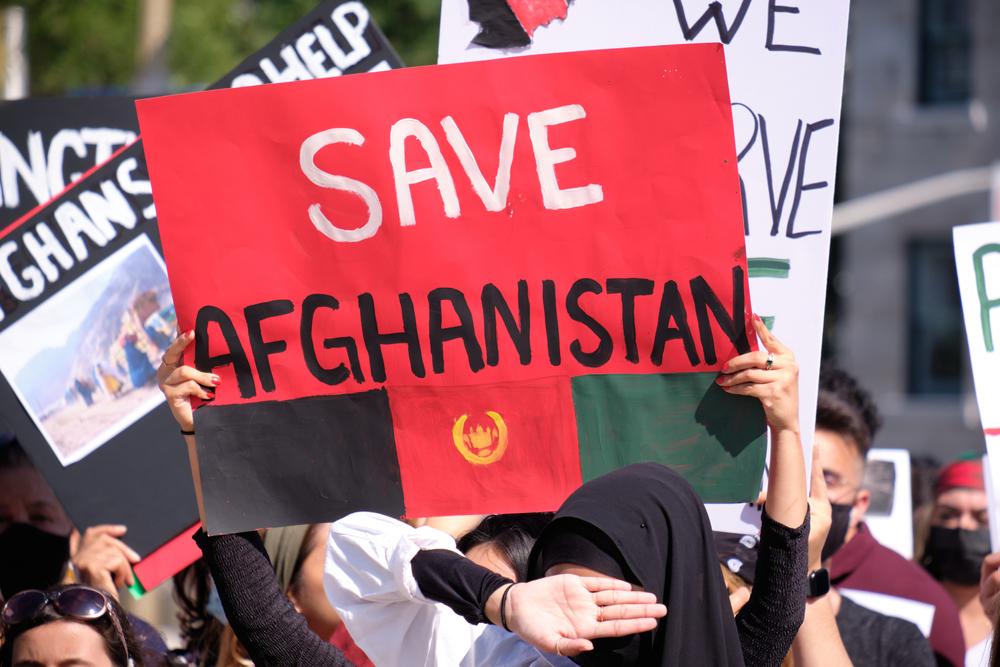
Afghanistan is in a major humanitarian crisis: the health sector is failing, the economy is collapsing, and amid the COVID pandemic, famine is inflicting ever-larger numbers of casualties. According to the most recent report by the UN World Food Programme, more than half of the resident population of 38 million are facing acute hunger and 3.2 million children under five suffer from malnutrition.
Droughts, combined with the suspension of foreign aid in the aftermath of the Taliban’s takeover, have led to a dire economic situation, with recent reports indicating that some families in the northwest are selling their children out of desperation. Food and fuel prices are soaring.
On October 17, the Taliban foreign minister, Amir Khan Mottaqi, called on the US Congress to ease sanctions and release Afghanistan’s reserves. But would the US$9.5 billion (£7.16 billion) of frozen assets of Afghanistan Central Bank do anything to alleviate the deeply rooted poverty and food insecurity of the Afghan people – or will this only benefit the Taliban and its fighters?
Even in the near term, this amount of money will not go far to address poverty in Afghanistan. It has been estimated the reserves would cover the import costs of Afghanistan for only 15 months. The US-backed regime’s budget estimate for the fiscal year 2020 was $6.22 billion.
The situation has been made worse by several other factors: drought, dependency on international aid and high unemployment rates. These extend far deeper and beyond the reach anything $9.5 billion could achieve. International aid made up about 75% of the US-backed regime’s budget. Afghanistan’s assets are only a fraction of the aid the country needs.
Skills deficit
It is naive to think that the Taliban’s caretaker cabinet and its civil service is able to administer these funds efficiently. The Taliban’s leadership lacks the knowledge, skill and experience needed to run state institutions and deliver services while managing an unfolding humanitarian crisis against the backdrop of a pandemic.
The skills that helped the Taliban win on the battlefield are not easily transferable. And more than half of the Taliban’s caretaker cabinet is on at least one designated terrorist list, which makes diplomatic engagement with the Taliban very difficult at the international level. At home, the Taliban leadership suffers from internal fragmentation that makes agreement on national-level public policy decisions difficult.
At the sub-national level, the Taliban has placed fighters in upper-level administration positions, while thousands of former government employees have either left their jobs or have been replaced with Taliban loyalists, according to my anonymous sources still living there. Women, who previously made up almost half of the civil service, have been almost entirely excluded. Taliban fighters placed at executive administrative levels lack the required managerial and leadership skills – some reportedly even lack basic literacy. The prospects of these people having the capacity to put the funds to productive use addressing the abject poverty in the country is very low.
Additionally, fears of misappropriation of National Bank’s assets are well-grounded. The limited international aid that has reached Afghanistan has occasionally been misappropriated and distributed among the Taliban fighters.
These concerns become all the more relevant given that the Taliban is not able to pay its fighters. The group has about 80,000 fighters who were paid 10,000-25,000 Afghanis (the equivalent of US$200-US$400) per month before the group took over Kabul. At the lower end, the Taliban needs at least $16m a month for the salaries of its fighters alone. Some of the Taliban’s fighters have reportedly defected to IS or al-Qaeda. The Taliban will undoubtedly lose more if it prioritises civilian spending over paying its fighters.
Political considerations
Finally, the release of Afghanistan’s foreign assets is tied to the question of the Taliban’s legitimacy. No government so far – including staunch supporter Pakistan – has officially recognised the Taliban’s government. Freezing Afghanistan’s assets was a political decision by US president Joe Biden to put pressure on the Taliban to form an inclusive government, so releasing these assets to the Taliban is akin to formal recognition of the Taliban as the legitimate government of Afghanistan. Even if it was released for entirely humanitarian reasons, the Taliban would not hesitate to make this into a propaganda coup.
Economic sanctions have been effective in some regards. The Taliban is realising that its survival depends on changing its policies, both regarding women’s rights and forming an inclusive government. The opening of schools for girls in cities such as Herat and Mazar-e Sharif is indicative of the effectiveness of pressure put on the Taliban both internationally and nationally.
But economic sanctions also have a dire impact on the civilian population. Although the UN raised $1.2bn in emergency funds, the international community is grappling with how to engage with the Taliban, deliver the much-needed aid – and yet not empower, legitimise and enrich the Taliban. Helping Afghans while bypassing the Taliban is possible. Unicef, for example, is setting up a system that will allow direct payment to teachers while bypassing the Taliban.
Afghanistan’s state power monopoly owes more than $90 million to its power suppliers in neighbouring countries such as Iran, Uzbekistan, Tajikistan and Turkmenistan. Given the deteriorating relationships between the Taliban and some of these countries, there are concerns that the suppliers might cut off electricity. International aid could be used to pay foreign electricity suppliers directly while denying the Taliban the opportunity to misappropriate funds.
Afghan civilians should not be subjected to starvation in a bid to pressure a government they did not put in office. Likewise, the international community has a responsibility to ensure the wealth of the Afghan people is not squandered by shortsighted Taliban desperately trying to cling to power.