
Volatility in developed market currencies are posing biggest challenge for professional and retail traders as with higher volatilities come with greater risk, along with risk of stopping out of trades. On other hand higher volatilities remain favorable for algorithmic traders.
- High volatility in currencies risk spill over to other asset classes. This year all the asset classes are facing high volatility risks.
- Last few trading days, saw very high intraday volatility in Euro based pairs as well as European sovereign debt securities. Yesterday alone 10 year bund yield moved 17 basis points which would be close to 20-30% intraday movement. 10 year Bund yield jumped to 0.75% from 0.59% to start with and finally closing in 0.58%.
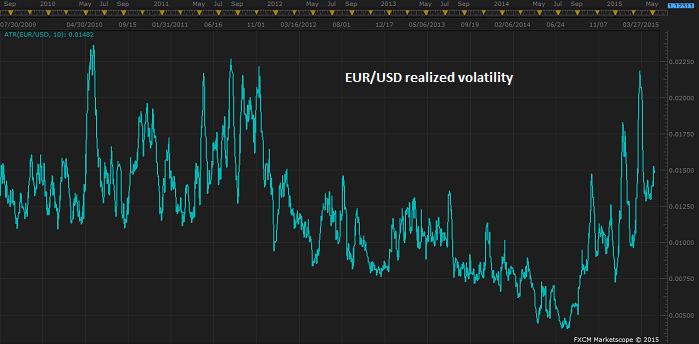
- Volatility clustering indicates that volatile days are not over. Euro realized volatility this year touched highest level since 2011 debt crisis. Chart is attached for reference. European Central bank's QE isn't depressing volatility unlike that of Federal Reserve's as Market remains tense over Greece and Fed rate hike prospect.
One of the key driver of volatility remains lack of liquidity in the market due to absence of traditional players such as banks and extreme positions in one sided trade. This has been exposed several times by SNB CHF move, flash crashes in both stock and bond market.
Short term traders might use momentum based strategies as they tend to do well during volatile times.


