More than half of Australian companies plan to scale back environmental initiatives to weather the financial harm caused by the COVID pandemic, a report released this month suggests. But such a move would be bad for business, and the planet.
Over the past few decades, regulatory and societal pressures have prompted businesses to adopt environmental initiatives at a growing rate. The measures may involve divesting from fossil fuels, preventing pollution, developing eco-friendly products or even collaborating with competitors to help other organisations in their supply chains, such as distributors and retailers, become sustainable.
My research focuses on social and environmental sustainability issues confronting organisations. Environmental initiatives require a long-term focus, and in my view, businesses would be unwise to scale back these measures in response to the pandemic. Research by myself and colleagues suggests most firms with good environmental performance also do well financially. And firms that ignore environmental issues face enormous risk.
Renowned US economist Milton Friedman famously argued, “the only social responsibility of business is to make profits”. But even Friedman suggests firms are better off dealing with environmental issues when they become a risk.
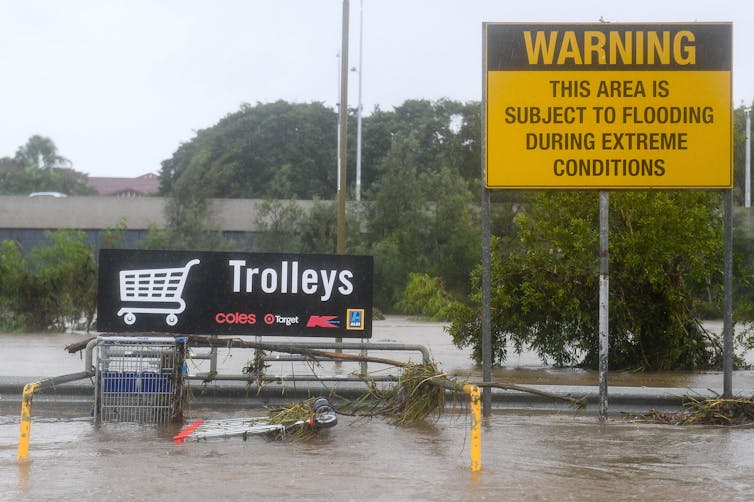
Climate change and extreme weather, such as heavy rainfall, is a business risk. Flooded supermarket carpark
Business can be a force for good
Sustainability measures by business are crucial in helping mitigate and adapt to climate change. Production processes creating fewer greenhouse gas emissions help slow global warming. And when firms make products that require fewer natural resources (such as by using recycled materials), this lowers stress on global ecosystems.
In fact, our research shows businesses can be one of society’s most powerful actors in bringing about fast and furious change on environmental and social sustainability.
However a recent international survey by Deloitte found 54% of 75 surveyed Australian companies were downgrading sustainability initiatives during the pandemic.
This is a troubling figure, but below the global average of 65%. And, it should be noted, no surveyed organisation planned to stop their efforts completely and not resume, indicating the changes will not be permanent.
The results are not necessarily representative of the entire Australian business sector. But as a general rule, slowing the momentum on environmental initiatives increases business exposure to climate risk – and may affect future profitability. A firm’s environmental capabilities can take decades to hone. They can involve complex strategies and years of consultations inside and outside the company. Stopping or slowing these actions can undo hard-earned gains.

Slowing the momentum on environmental initiatives increases business exposure to climate risk. Shutterstock
In recent years, the business community has increasingly recognised how climate change and other environmental damage poses a risk to their returns. These risks include:
- extreme weather which disrupts operations, damages infrastructure and increases insurance costs
- increased business costs due to scarcer resources
- lower consumer demand for unsustainable products
- stranded assets (those that can’t make a financial return due to changes in technology, regulation or the market)
- reputation damage and shareholder backlash.
Rio Tinto experienced the latter last year after its disastrous decision to blow up two ancient rock shelters at Juukan Gorge. The move prompted public outrage and enraged shareholders forced the resignation of Rio’s chief executive, Jean-Sébastien Jacques.
And shareholders in Australian energy giant AGL have urged its board to hasten the closure of its coal-fired power stations.
Sustainable business activities need not damage a business’ financial returns. This month it was reported that BlackRock, the world’s largest asset manager, had examined divestment by hundreds of funds and concluded the portfolios experienced “modest improvement in fund return”.
Flattening the climate curve
Rather than abandoning environmental initiatives, governments, businesses and societies should use the pandemic to reset our collective response to climate change.
For businesses, the pandemic presents a unique opportunity to rethink how they engage with their workforce. Do businesses really need all their energy-guzzling office buildings? Do their employees need to commute to work every day? Is international travel necessary? Can they pool scarce resources and work with competitors to gain traction on environmental issues?
For governments, this is a good time to seriously consider pricing carbon, which financially penalises high-emitting companies. Renewable energy is becoming more reliable each year – strengthening the case to move to a low-carbon economy.
Governments should also consider earmarking a decent fraction of further stimulus payments to encourage business action on climate change. After the global financial crisis in 2007-09, many national governments issued financial stimulus to kickstart economies. Pioneering electric carmaker Tesla emerged from one such stimulus loan in the United States.
And more broadly, as a capitalist society, must we continue on the path of incessant economic growth that is making our planet sick? Or can we use the pause caused by this pandemic to take a more sustainable route?
A dry run
The COVID-19 pandemic can be viewed as a dry run for the impending climate crisis. But the size and scale of climate change demands much more sustained commitment and action than the pandemic. Successfully flattening the emissions curve will take decades, not months.
And the pain from climate change, while slower to arrive, will last much longer, and perhaps forever change civilisation as we know it.
Businesses have long been a big part of the climate problem. They, along with governments and society, cannot continue their uncoordinated, piecemeal response to climate change. This includes not dumping environmental initiatives when it all feels too hard.