


 AI Agents Could Disrupt Financial Services, Bernstein Says
  NEAR Intents Hack Drains $3.8 Million, NEAR Price Falls 7.5%
  XRP Asia Launches to Accelerate XRPL Adoption Across Asian Banks
  Bitcoin Holds Above $83,700 as High Treasury Yields Limit Rally
  Bank of America Sees EUR/USD at 1.15 by Year-End
  Hyperliquid Sets $856 Million HYPE Token Unlock for October
  Midnight NIGHT Token Surges 86% as Smart Contract Launch Nears
  Cardano Price Struggles as NIGHT Token Surges 20%
  TRUMP Memecoin Launches New Dinner Contest
  Citi Raises Bitcoin Price Target to $113,000 on ETF Optimism
  Evernorth Set for Nasdaq Debut With 473 Million XRP Treasury
  Standard Chartered Sees Ethena ENA Hitting $2 by 2028
  WordPress Malware Uses Ethereum to Evade Removal
  Zcash Awards $8 Million in Grants After Orchard Bug Crisis
  XRP Ledger Hits 10 Million AI Payments as Bitcoin Retreats
  Robinhood Stock Nears $114 as Jobs Data Boosts Risk Appetite
  Bitcoin Exchange Reserves Hit Multi-Year Low at 2.68 Million BTC


 Add as a preferred source on Google
The economic slowdown in China and the accompanying slump in commodity prices a catastrophe for Russia's currency and economy. An ailing economy already squeezed by Western sanctions, has been sent into virtual free fall. Russia's economy contracted by 4.6 percent y/y in the second quarter. After a decline of 2.2 percent in the previous quarter, this marks Russia's deepest recession since the 2008-2009 financial crisis.
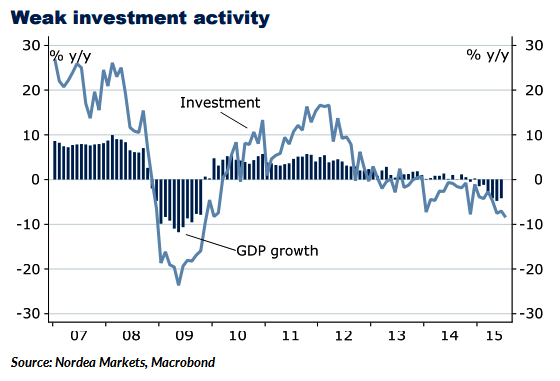
"In 2015 we expect GDP to decline by 3.7% mainly due to lower investment activity and weak household consumption driven by weak oil market dynamics", says Nordea Research in report.
The biggest threat to the country's recovery in the long run comes from household consumption, which remains under pressure due to relatively high inflation driving a negative trend in real wages. CPI growth peaked in April 2015 and in line with expectations has started decelerating due to a much higher CPI base, weak consumer demand.
"By the end of 2015 inflation may reach 11.4%. Household consumption may remain weak; after the anticipated 7% drop in 2015 we expect sluggish consumption growth of 0.5% in 2016. Investment activity will likely continue to decline", estimates from Nordea Research noted.
As a result of the recession, the Central Bank of Russia may need to take even firmer action to target inflation and help the recovery of real incomes and consumption. In July, the central bank cut its key interest rate by a further 50 basis points. Government's implementation of anti-crisis measures coupled with the central bank's accommodative monetary policy line will support investment in the long run. In 2015 and 2016 CBR is expected to continue easing its policy slowly.
The Russian ruble continues to experience downward pressure against the USD. Since the end of July, the RUB's depreciation reached as high as 20% per USD in August, underpinned by renewed declines in global oil prices and weaker economic growth prospects in China. While the RUB has retraced some of its losses, Russian assets remain vulnerable to capital reallocation shifts ahead of US monetary normalization, while the country's dovish central bank and weak economic fundamentals will continue to weigh on the RUB.
"The end of 2015 may turn out to be a volatile period for the rouble given the rather intense external corporate debt redemption calendar. We expect USD/RUB to remain weaker than the "acceptable corridor" of 50-60 through mid-2016. USD/RUB is forecast to end the year at 69.0", said Scotiabank in a research note to its clients.
The rouble edged up on Thursday, continuing Wednesday's rally, when international oil prices shrugged off weekly U.S. oil inventories data showing a large build-up in crude stocks. At 0800 GMT, the rouble was 0.2 percent stronger against the dollar at 66.97 and flat at 75.28 versus the euro.

- News

- Economy

- Central Banks
- Investing
- Research
- Roundups
- Digital Currency
- Insights
- Technical Analysis
- Technology
- Business
- Law
- Health
- Nature
- Fintech
- Science
- Topic
- Opinions
- ©Econometrics LLC . All Rights Reserved.
Russia in the middle of recession, Ruble to turn more volatile by end-2015
Thursday, September 3, 2015 9:59 AM UTC
Editor's Picks



- Market Data
Most Popular




