


 Wall Street Falls as Fed Minutes Signal Another Rate Hike
  Gold Prices Rise as Hormuz Tensions Fuel Inflation Risks
  European Stocks Fall as Oil Rises Ahead of Fed Minutes
  US Stock Futures Flat as Fed Minutes, Earnings Loom
  Trump Secures Russian Diesel Deal as US Fuel Prices Surge
  Gold Prices Hit One-Week High as Oil Falls, Fed Rate Outlook Weighed
  US Dollar Hits 18-Month High as Fed Signals More Rate Hikes
  France to Release 10 Million Barrels of Diesel to Ease Fuel Prices
  Gold Prices Rise as Dollar Weakens, Treasury Yields Fall
  Gold Prices Fall Amid Rate Jitters; Copper Steady as China Stimulus Eyed
  US Treasury Yields Ease After Strong 10-Year Auction as Global Bonds Struggle


 Add as a preferred source on Google
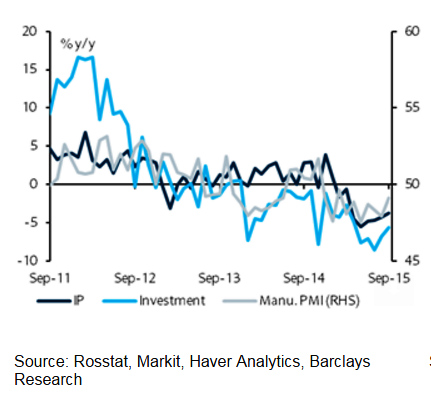
Russia's September real sector indicators provide some encouragement. Production indicators signal that the decline may have hit bottom and production is no longer declining. However, household consumption indicators imply further downside risks.
On the optimistic side, the decline in industrial production lessened to -3.7% y/y. This was the fourth monthly improvement from the nadir in May of -5.5% y/y. In addition, the seasonally adjusted index has improved off recent lows.
"This suggests that the industrial production decline has abated and there may be no further drop, although it is too soon to conclude that industrial production is ready to start increasing. Investment also appears to have turned the corner: improving for the second month to -5.6% y/y from the low of -8.5% in July", says Barclays.
Manufacturing PMI improved in September to 49.1, near the neutral level. Finally, unemployment fell to 5.2% from 5.3%. This is a reasonably uniform picture that the declines have ceased.
On the pessimistic side, indicators imply that household spending may fall further. Retail sales deteriorated to -10.4% y/y in September, considerably worse than last month and expectations, indicating that further declines in consumption are likely.
Real wages remained in deep decline, falling -9.7% y/y in September, only slightly better than the previous month. However, unemployment unexpectedly declined in September to 5.2% implying that employers are keeping wages low instead of laying off workers. It is possible that cutting employment will come later in the cycle if output levels remain depressed for an extended period.
"Overall, these indicators are interpreted to imply that the economy is near the bottom of its cycle and that the recession will not deepen much further. However, they provide no indication of a speedy recovery. A gradual L-shaped recovery is more likely from this recession as opposed to the previous V-shaped recoveries that Russia enjoyed in 1999 and 2009", added Barclays.

- News

- Economy

- Central Banks
- Investing
- Research
- Roundups
- Digital Currency
- Insights
- Technical Analysis
- Technology
- Business
- Law
- Health
- Nature
- Fintech
- Science
- Topic
- Opinions
- ©Econometrics LLC . All Rights Reserved.
Russia's economy likely near bottom of the cycle
Tuesday, October 20, 2015 4:31 AM UTC
Editor's Picks



- Market Data
Most Popular




