As the coronavirus spreads into more and more communities, public health officials are placing responsibility on individuals to help slow the pandemic. Social distancing is the way to do it. Geriatrician Thomas Perls explains how this crucial tool works.
What is social distancing?
Social distancing is a tool public health officials recommend to slow the spread of a disease that is being passed from person to person. Simply put, it means that people stay far enough away from each other so that the coronavirus – or any pathogen – cannot spread from one person to another.
The Centers for Disease Control and Prevention describes social distancing as staying away from mass gatherings and keeping a distance of 6 feet or 2 meters – about one body length – away from other people. In New York City, for example, theaters have closed temporarily, many conventions around the world are being canceled and schools are closing all across the U.S. I’ve stopped taking the train during rush hour. Now I either work from home or drive in with my wife, or I take the train during off-hours so I can maintain the 6-foot distance.
Social distancing also means not touching other people, and that includes handshakes. Physical touch is the most likely way a person will catch the coronavirus and the easiest way to spread it. Remember, keep that 6-foot distance and don’t touch.
Social distancing can never prevent 100% of transmissions, but by following these simple rules, individuals can play a critical role in slowing the spread of the coronavirus. If the number of cases isn’t kept below what the health care system can handle at any one time – called flattening the curve – hospitals could become overwhelmed, leading to unnecessary deaths and suffering.
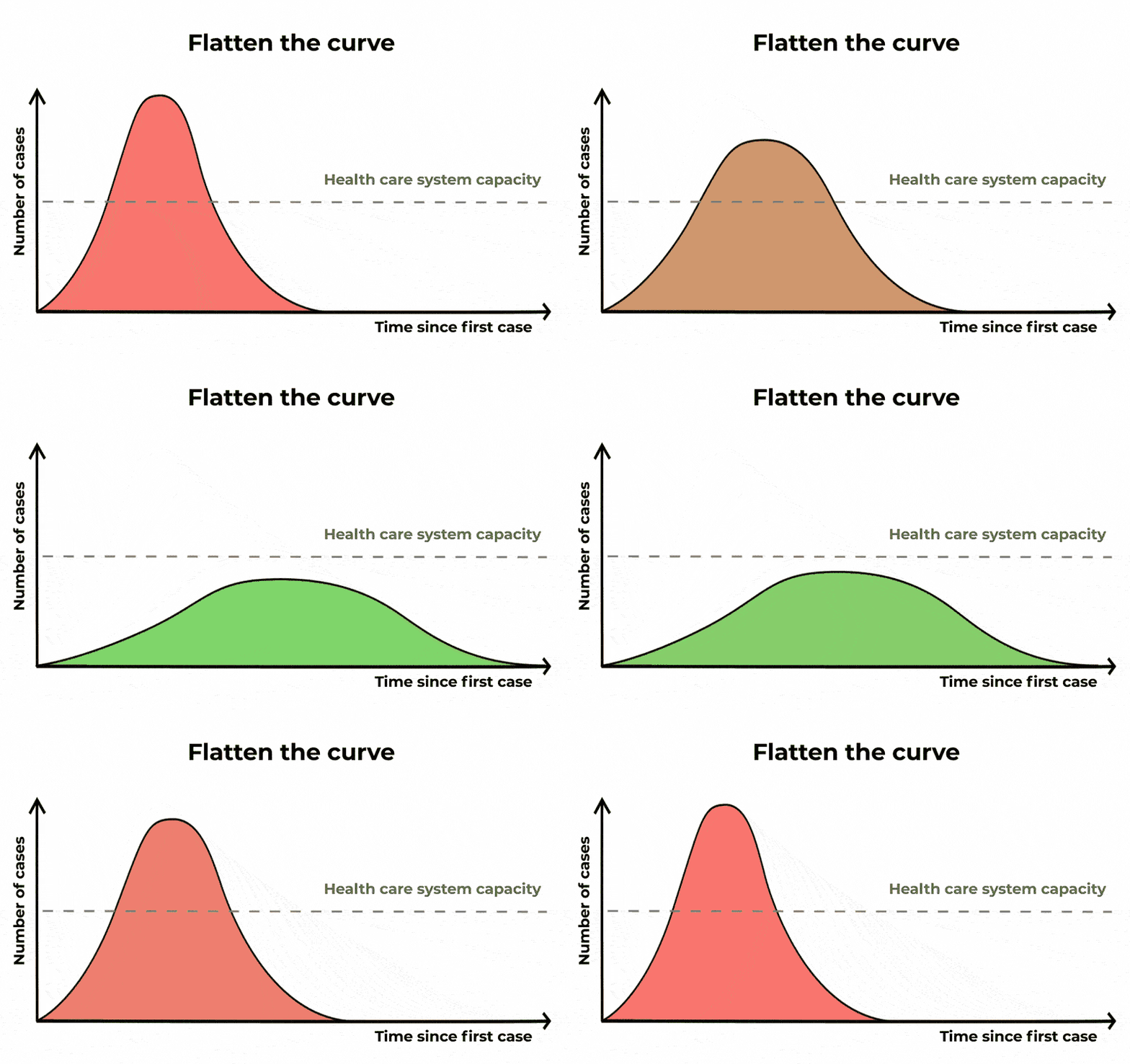
Flattening the curve is another way of saying slowing the spread.
There are a few other terms besides social distancing that you are likely to hear. One is “self-quarantine.” This means staying put, isolating yourself from others because there is a reasonable possibility you have been exposed to someone with the virus.
Another is “mandatory quarantine.” A mandatory quarantine occurs when government authorities indicate that a person must stay in one place, for instance their home or a facility, for 14 days. Mandatory quarantines can be ordered for people who test negative for the virus, but have likely been exposed. Officials have imposed mandatory quarantines in the U.S. for people on cruise ships and those traveling from Hubei province, China.
Why does social distancing work?
If done correctly and on a large scale, social distancing breaks or slows the chain of transmission from person to person. People can spread the coronavirus for at least five days before they show symptoms. Social distancing limits the number of people an infected person comes into contact with – and potentially spreads the virus to – before they even realize they have the coronavirus.
It’s very important to take a possibility of exposure seriously and quarantine yourself. According to recently published research, self-quarantine should last 14 days to cover the period of time during which a person could reasonably present with symptoms of COVID-19, the disease caused by the coronavirus. If after two weeks they still don’t have symptoms, then it’s reasonable to end the quarantine. Shorter quarantine periods could happen for asymptomatic people as tests to rule out the virus become widely available.
Why is social distancing so crucial?
At the moment, it’s the only tool available to fight the spread of the coronavirus.
Experts estimate that a vaccine is 12 to 18 months away. For now, there are no drugs available that can slow down a coronavirus infection.
Without a way to make people better once they fall sick or make them less contiguous, the only effective tactic is making sure hospital-level care is available to those who need it. The way to do that is to slow or stop the spread of the virus and decrease the number of cases at any one time.
Who should do it?
Everyone must practice social distancing in order to prevent a tidal wave of cases. I am a geriatrician who cares for the most vulnerable people: frail older adults. Certainly, such individuals should be doing all they can to protect themselves, diligently practicing social distancing and significantly changing their public ways until this pandemic blows over. People who are not frail need to do all they can to protect those who are, by helping to minimize their exposure to COVID-19.
If the public as a whole takes social distancing seriously, overwhelming the medical system could be avoided. Much of how the coronavirus pandemic unfolds in the U.S. will come down to individuals’ choices.