

Social media was recently credited with reducing the number of casualties caused by air strikes in the Syrian civil war. The early warning system, developed by tech startup Hala Systems, uses remote sensors to detect aircraft flying over the opposition-held northern province of Idlib. Alerts are then sent via Facebook and instant messaging apps such as WhatsApp to civilians and aid workers in affected areas. These messages give relevant information such as the areas likely to come under heavy bombardment and the duration of these raids.
Since its launch in 2016, the system has reportedly reduced the number of casualties in the region caused by air strikes by as much as 27%. The system also triggers traditional air raid sirens that might actually be more effective than social media in reaching key demographics in affected areas. Nevertheless, this example shows why social media has become big news for emergency managers seeking to provide accurate and timely information to people affected by disasters.
Incidents such as Hurricane Sandy in September 2012 have shown how disaster response teams can leverage the “power of collective intelligence” given by social media. Members of the public use these platforms to share critical information that helps build a bigger picture of the situation. They also play a key role in correcting misinformation and dispelling rumours that have the potential to hinder efforts to restore critical services in affected areas.
Twitter hashtags in particular function as “fire spaces”, transforming data generated by citizens into information that helps first responders allocate resources to the people who need them most. Emergency managers frequently use information-gathering platforms such as Ushahidi and Twitcident to help them sift through the large volume of data available on these sites at each stage of the incident.
They have also mobilised “digital volunteers” who offer their time without having to leave home to assist with this task. Groups such as the Virtual Operations Support Teams and the Digital Humanitarian Network helped analyse the social media data generated during natural disasters such as Hurricane Harvey, as well as terrorist incidents such as the November 2015 Paris terrorist attacks.
Social media can also be used by citizens to provide emotional and material support to those living in disaster-affected areas. Our research projects CascEff and IMPROVER found several examples of such citizen-led social media campaigns. These included #hasselthelp, which provided shelter to those festival goers who had fled the 2011 Pukkelpop festival disaster. And #PorteOuverte, which fulfilled the same function for those caught up in the Paris terrorist attacks.
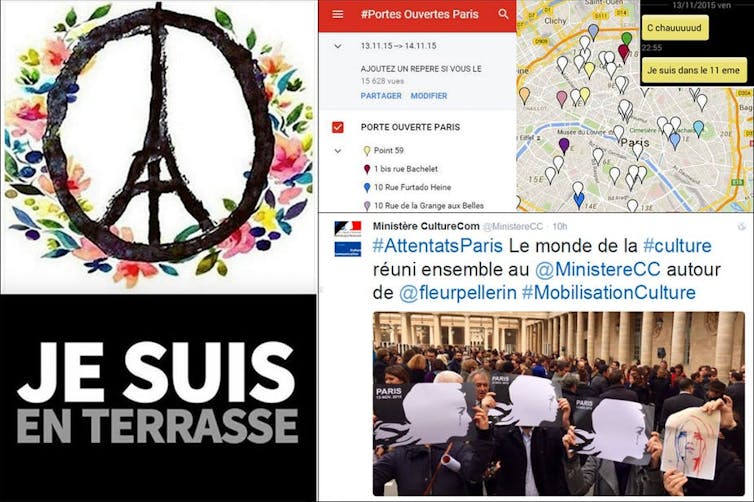
Leighton Walter Killé/TCF, CC BY-ND.
These hashtags appeared to empower local communities to join in disaster response, theoretically increasing their resilience towards such incidents in the future. Yet social media users typically disengaged from these online groups once their questions about the incident had been answered. And we found that they didn’t necessarily show a stronger commitment to responding to the disasters. What’s more, emergency management organisations are likely to remain the most influential and reputable sources of crisis information for the foreseeable future.
The problem with relying on digital media for disaster response is that not everyone has access to it. Many people are still sceptical about the trustworthiness and reliability of information posted online. Research shows that members of the public are still more likely to perceive traditional media such as newspapers, radio and television as more credible than social media.
Mixing old and new
Because there’s always a risk of mobile networks also going down, any communication strategy has to involve a mix of traditional and digital media. Our research found that radio was still seen as the most resilient communication channel that could help reach large numbers of people when power supplies were disrupted.
Our work also suggests there aren’t any ways social media is used that make it indispensable to emergency managers. Instead, they need to assess how people are behaving and the information they need to work out the best way to communicate in any scenario, including by learning lessons from previous disasters.
Overly optimistic views of social media as a panacea for the problems in crisis communication often ignore the importance of a mix of traditional and digital tools. Perhaps that’s why the Syrian air strike warning system, which sounded conventional alarms based on data gathered by social media, has proved so successful.

