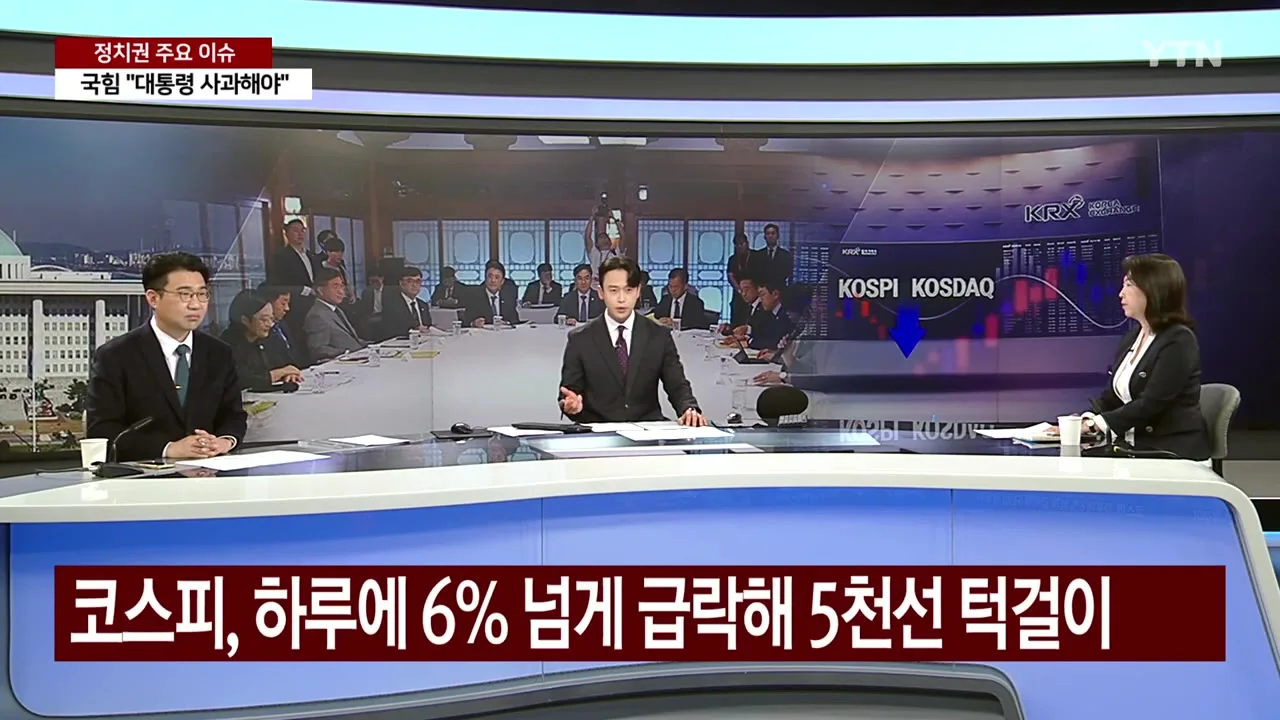
South Korea’s government should explain its promotion of stock investment following a market slump, Won Young-seop, a former People Power Party media legal affairs chief, said, calling for an end to politicising equities.
The dispute centred on whether government encouragement of stock investment made it responsible for losses or whether global developments explained the decline. Won spoke during a YTN discussion published Nov. 8.
The discussion began with firefighting finances. Jang Yoon-mi, a former Democratic Party spokesperson, said firefighters’ national civil servant status had left funding heavily dependent on local taxes. Talks would address funding arrangements and additional money to improve working conditions.
Turning to stocks, Won accused the government of encouraging investment for electoral purposes. Anyone who sold an apartment to buy shares on that advice could face “asset destruction,” he said in remarks translated from Korean.
Jang said global developments contributed to the decline, citing concerns about tighter US data centre regulation following Democratic election gains. She said efforts to draw money from property into shares should continue.
Park Yong-jin, vice-chair of the Regulatory Rationalisation Committee, bought 10 million won of shares during the selloff, Jang said. She opposed making daily stock movements a partisan dispute and defended efforts to improve the market.
The discussion then turned to justice minister nominee Lee Yong-cheol and allegations connecting him to the Daejang-dong property development controversy. Won said Lee needed to explain his work in Seongnam beyond denying involvement.
Jang rejected attempts to connect Lee’s favourable assessment of Yoo Dong-gyu for a municipal facilities management post to the development. The relevant development corporation began operating four years later, she said. Other selection committee members also ranked Yoo first.
Won said Lee’s position on withdrawing charges against President Lee Jae-myung would be central to his confirmation hearing. He criticised the nominee for postponing an answer. Jang said the hearing was the appropriate place for a detailed explanation.
On legislation establishing a special prosecutor to investigate allegations of fabricated prosecutions, Won said the measure could protect the president instead of checking those in power. Removing an explicit provision on withdrawing charges did not eliminate that possibility, he said.
Won argued that provisions applying ordinary criminal procedure could still allow charges to be withdrawn. He said the People Power Party should consider a constitutional challenge. Jang rejected the constitutional objections, saying lawmakers could temporarily grant investigative powers to prosecutors assigned to the inquiry.
Jang also rejected the argument that presidential appointment of the special prosecutor necessarily created a conflict of interest. She said other investigative bodies also fell under government ministries, while the special prosecutor would operate independently.
The final exchanges concerned a possible Democratic Party merger with the Rebuilding Korea Party. Jang said both parties shared an electoral interest in joining forces, although disagreements remained over timing and arrangements.
She said a proposed January deadline reflected the need to allow at least six months for membership recruitment before internal candidate selection. Won described disputes within the Democratic Party as a struggle over nominations and dismissed talk of alliances within his former party.
The discussion left unresolved what Lee would say about withdrawing charges, whether opponents would pursue a constitutional challenge and whether the parties would agree on a merger timetable.