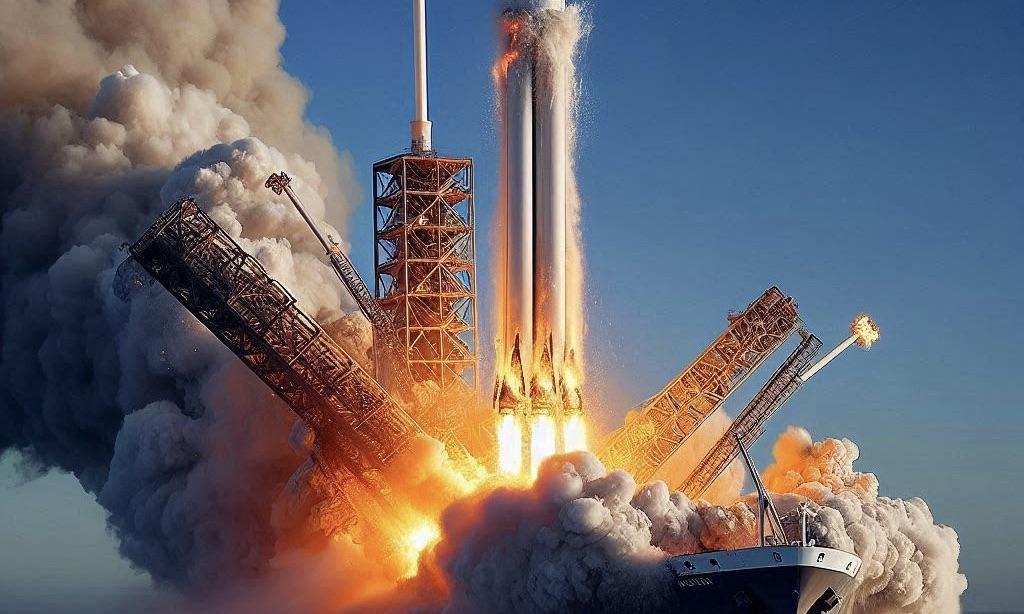
In a rare incident, a SpaceX Falcon 9 booster toppled over on a drone ship after its 23rd launch, resulting in a fiery scene shortly after deploying Starlink satellites into orbit.
Falcon 9's 23rd Launch Ends in Rare Mishap as Booster Topples on Recovery Drone Ship
SpaceX successfully launched the latest cargo of Starlink satellites into orbit, but the company's veteran Falcon 9 booster disintegrated on the recovery drone ship shortly after that. SpaceX said the booster had completed its 23rd launch on August 28. This was a rare incidence.
Unfortunately, it failed to maintain stability after landing on the company's drone ship, A Shortfall of Gravitas. Although the rocket initially touched down successfully, it could not sustain its balance and eventually tipped over. This marked the first time a booster had completed 23 launches, a milestone captured in SpaceX’s live stream.
SpaceX’s 83rd mission of the year took place on August 28, shortly after the initially scheduled launch of the Polaris Dawn mission was postponed. Polaris Dawn, one of SpaceX’s most ambitious missions, aims to take a crew of four to the highest Earth orbit since the Apollo era of the 1970s. The Falcon 9 rocket was launched from Cape Canaveral Space Force Station in Florida, marking its 23rd flight. The rocket was scheduled to land on SpaceX's drone ship, A Shortfall of Gravitas, which was stationed nearby.
According to Wccftech, the launch occurred at 3:38 a.m. local time and proceeded as expected. The rocket reached maximum aerodynamic pressure approximately one minute after liftoff. It continued its flight for another minute before the second stage’s Merlin vacuum engine ignited, separating from the first stage.
Around eight minutes and twenty seconds after liftoff, the Falcon 9 approached SpaceX’s drone ship. By this point, the rocket had completed its boost-back and landing burns, and everything seemed progressing smoothly. However, the final moments did not go as planned, leading to an unusual mishap for SpaceX.
Falcon 9 Booster Tips Over After Fiery Landing, SpaceX Investigates Drone Ship Incident
Footage showed the rocket’s base struggling to extinguish the flames after landing, a process usually achieved on a drone ship or land. The Falcon 9 appeared to lose its balance, and the fire intensified. The rocket slowly tilted to one side before coming to rest horizontally. Smoke and fire continued to billow from its rear.
SpaceX quickly acknowledged the incident on its social media platform. In a post on X, the company stated that the “Falcon 9’s first stage booster tipped over following touchdown on the A Shortfall of Gravitas droneship.” It added that the “booster’s flight data and status will be evaluated,” without specifying whether the findings would be made public. Meanwhile, the second stage completed its first engine burn and continued its journey, preparing for the deployment of the latest batch of Starlink satellites.