


 Nasdaq Faces Pullback to 26,225 Despite Bullish Outlook, UBS Says
  Want to cut your energy bills? Here’s how five experts are doing it
  Binance to Shut Down Crypto Mining Pool Services on November 10
  Epic Games Delays Disney Shooter, Shifts to AI-First Development
  Moonshot AI Executives Seek Settlement Ahead of Hong Kong IPO
  How to support someone who is grieving: five research-backed strategies
  Why a ‘rip-off’ degree might be worth the money after all – research study
  Canton Network Expands in South Korea With Major Partnerships
  Samsung, SK Hynix Shares Fall as China's CXMT Advances DRAM Technology
  Disaster or digital spectacle? The dangers of using floods to create social media content
  Most Americans Oppose Election Betting on Prediction Markets, Poll Finds
  Morgan Stanley Predicts $10 Trillion RWA Market by 2030
  What is Zionism? The different meanings of a contested term
  Apple Supplier Luxshare Faces US Patent Probe, Sees Limited Impact
  Heritage, desire and diplomacy: why China still values scotch whisky


 Add as a preferred source on Google
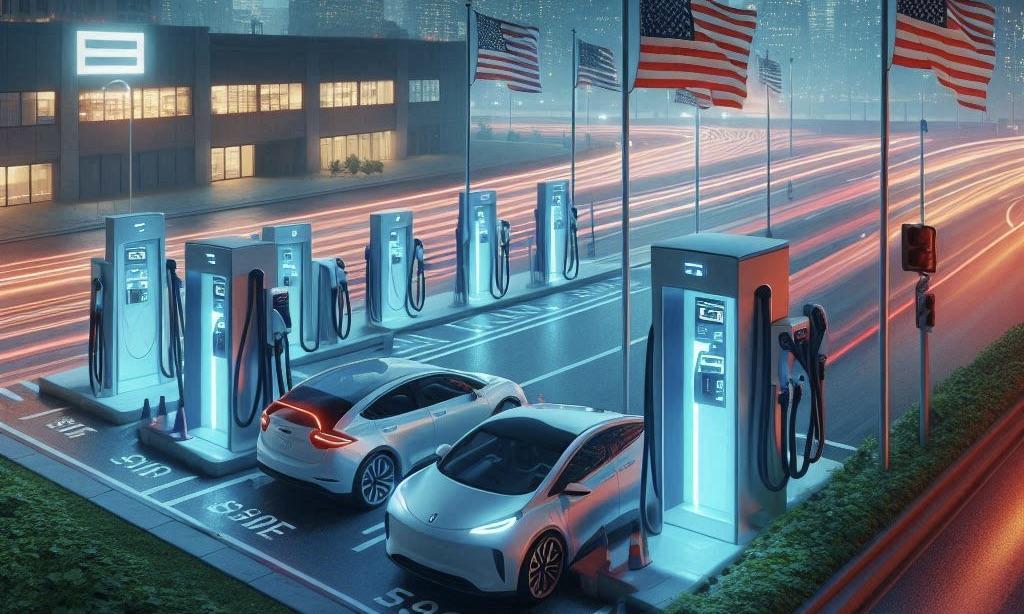
The United States is investing $521 million in grants to construct over 9,200 electric vehicle charging stations. This initiative, part of a broader push to double public charging terminals, aims to strengthen the EV infrastructure across the nation, enhancing accessibility and supporting widespread adoption.
U.S. Commits $521 Million to Build 9,200 EV Charging Stations, Doubling Public Charging Network
According to Teslarati, the United States intends to construct over 9,200 electric vehicle (EV) charging terminals. It will provide up to $521 million in grant funding to assist in developing the electric vehicle (EV) charging infrastructure.
According to a press release shared on August 27 by the Energy Department and Federal Highway Administration (FHWA), the Biden administration will allocate $321 million to 41 community initiatives to expand EV charging and $200 million to 10 corridor fast-charging projects.
These will consist of $15 million allocated to a 53-site EV network in Milwaukee, Wisconsin, and $11.8 million allocated to a 50-plug DC Fast-Charging Hub at the Atlanta, Georgia, airport. The hub is intended to maintain the charging status of rentals, shuttles, and ride-hailing vehicles.
The White House has targeted doubling the number of public charging terminals in the United States to 500,000, including fast-charging stations. These stations will be 50 miles apart along the nation's busiest highways. According to Reuters, the United States had 192,000 public charging terminals as of August.
The Biden administration announced $5 billion in 2022 for the National Electric Vehicle Infrastructure (NEVI) charging infrastructure program. However, the deployment of chargers has been delayed. The initial fast-charging station was established in Ohio last December, and the NEVI funding recipients in Virginia were announced in March, along with approximately $11.3 million in grants.
Slow Rollout of EV Stations Sparks Concern as Tesla Leads Fast-Charging Network Expansion
In June, the program had only deployed approximately seven stations, according to FHWA Head Shailen Bhatt, who expressed dissatisfaction with the pace during a monthly hearing. Bloomberg recently predicted that the number of public charging sites in the United States would surpass that of gas stations by 2032, and the FHWA is presently deploying approximately 1,000 new public chargers each week.
Tesla continues to be the industry leader in the deployment of fast-charging stations, and J.D. Power recently recognized the network as the most dependable. Even though the network was previously exclusively accessible to Tesla vehicles, the company began allowing non-Tesla EVs to access it earlier this year. As a result, manufacturers from across the industry are preparing to construct future-generation cars with Tesla's North American Charging Standard (NACS) plug.







