On April 20, 2023, a new SpaceX rocket called Starship exploded over the Gulf of Mexico three minutes into its first flight ever. SpaceX is calling the test launch a success, despite the fiery end result. As a space policy expert, I agree that the “rapid unscheduled disassembly” – the term SpaceX uses when its rockets explode – was a very successful failure.
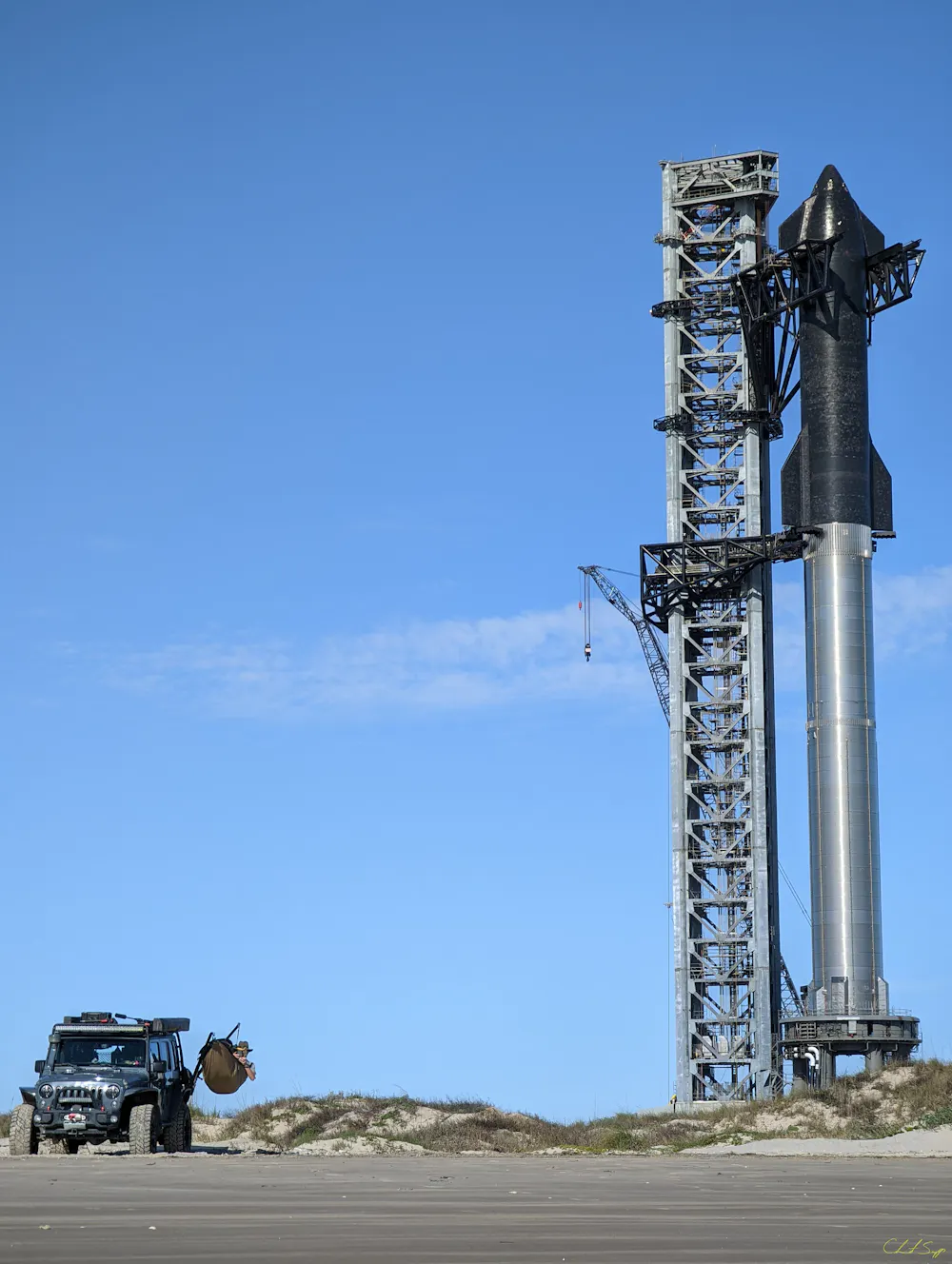
The full Starship stack comprises a Starship spacecraft (in black) on top of a rocket dubbed Super Heavy (in silver) and is nearly 400 feet (120 meters) tall. Hotel Marmot/Flickr, CC BY-SA
The most powerful rocket ever built
This launch was the first fully integrated test of SpaceX’s new Starship. Starship is the most powerful rocket ever developed and is designed to be fully reusable. It is made of two different stages, or sections. The first stage, called Super Heavy, is a collection of 33 individual engines and provides more than twice the thrust of a Saturn V, the rocket that sent astronauts to the Moon in the 1960s and 1970s.
The first stage is designed to get the rocket to about 40 miles (65 kilometers) above Earth. Once Super Heavy’s job is done, it is supposed to separate from the rest of the craft and land safely back on the surface to be used again. At that point the second stage, called the Starship spacecraft, is supposed to ignite its own engines to carry the payload – whether people, satellites or anything else – into orbit.
An explosive first flight
While parts of Starship have been tested previously, the launch on April 20, 2023, was the first fully integrated test with the Starship spacecraft stacked on top of the Super Heavy rocket. If it had been successful, once the first stage was spent, it would have separated from the upper stage and crashed into the Gulf of Mexico. Starship would then have continued on, eventually crashing 155 miles (250 kilometers) off of Hawaii.
During the SpaceX livestream, the team stated that the primary goal of this mission was to get the rocket off the launch pad. It accomplished that goal and more. Starship flew for more than three minutes, passing through what engineers call “max Q” – the moment at which a rocket experiences the most physical stress from acceleration and air resistance.
According to SpaceX, a few things went wrong with the launch. First, multiple engines went out sometime before the point at which the Starship spacecraft and the Super Heavy rocket were supposed to separate from each other. The two stages were also unable to separate at the predetermined moment, and with the two stages stuck together, the rocket began to tumble end over end. It is still unclear what specifically caused this failure.
Starship is almost 400 feet (120 meters) tall and weighs 11 million pounds (4.9 million kilograms). An out-of-control rocket full of highly flammable fuel is a very dangerous object, so to prevent any harm, SpaceX engineers triggered the self-destruct mechanism and blew up the entire rocket over the Gulf of Mexico.
All modern rockets have mechanisms built into them that allow engineers to safely destroy the rocket in flight if need be. SpaceX itself has blown up many of its own rockets during testing.
Success or failure?
Getting to space is hard, and it is not at all unusual for new rockets to experience problems. In the past two years, both South Korea and Japan have attempted to launch new rockets that also failed to reach orbit. Commercial companies such as Virgin Orbit and Relativity Space have also lost rockets recently. None of these were crewed missions, and in most of these failed launches, flight engineers purposefully destroyed the rockets after problems arose.
SpaceX’s approach to testing is different from that of other groups. Its company philosophy is to fail fast, find problems and fix them with the next rocket. This is different from the more traditional approach taken by organizations such as NASA that spend far more time identifying and planning for possible problems before attempting a launch.
The traditional approach tends to be slow. The development of NASA’s Space Launch System – the rocket that will take astronauts to the Moon as part of the Artemis program – took more than 10 years before its first launch this past November. SpaceX’s method has allowed the company to move much faster but can be costlier because of the time and resources it takes to build new rockets.
SpaceX engineers will look to identify the specific cause of the problem so that they can fix it for the next test launch. With this approach, launches like this first Starship test are successful failures that will help SpaceX reach its eventual goal of sending astronauts to Mars.