The last few years have been troubling for the British steel industry. High energy costs, a wave of cheap Chinese imports, plant closures, the COVID pandemic and financial struggles have all taken their toll.
Steel is a high energy user and significant carbon emitter. Coal-fired blast furnaces exceed temperatures of 2,000°C and the industry is responsible for around 2% of UK greenhouse gas emissions. The sector faces the challenges of transitioning to greener and more cost-efficient production.
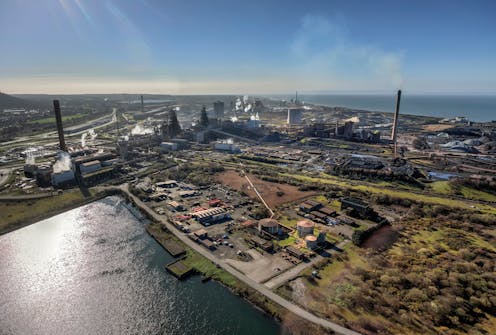
Such challenges are especially acute at the UK’s largest steelworks at Port Talbot in South Wales. Owned by Tata Steel, the site recently closed one coal blast furnace with a second one due to shut in September.
The blast furnaces were said to be losing the company around £1 million a day, and the closures will mean about 3,000 jobs could be lost. They will be replaced by new, more flexible, and “cleaner” electric arc furnaces, which will operate with a much lower workforce. These furnaces use electricity instead of coke to create heat, and are more energy- and space-efficient than blast furnaces.
A concern here is that these new arc furnaces will not be able to produce “virgin steel” or some high-quality steel varieties, leaving the UK as the only G20 country in this position and dependent on imports. Unions and some commentators have suggested a slower decommissioning of blast furnaces.
The new government recently kicked off negotiations with Tata Steel to facilitate this transition and save as many jobs as possible.
Steel in the UK
In the early 1970s, the UK was the second-largest steel producer in Europe. But since then, steel industries in other major European countries have been better able to withstand global pressures. Since the 1970s, no other country apart from Venezuela has seen its steel production fall faster than the UK.
Yet, the UK steel industry still supports 33,000 jobs and accounts for 1.2% of manufacturing output. Most of these jobs are highly skilled, and there is a strong regional dimension – more than 70% of jobs are in Wales, Yorkshire and Humberside and the West Midlands.
The Port Talbot steelworks, for instance, contributes around 3% of Wales’s national output and pays wages more than a third higher than the UK average. The closure of any steelworks is therefore politically sensitive and will have major local economic impacts.
Steel is a “foundational industry” – its products support a range of other sectors including automotive, aerospace, construction and infrastructure (HS2 high-speed rail project and Hinkley Point C nuclear power station, for example), housing and defence. Steel also plays an important role in the transition to a low-carbon economy – it’s a component in wind turbines, EVs, energy-efficient products and green infrastructure. These are all part of the new government’s growth strategy.
If the UK were to lose its steel industry entirely or operate at a reduced capacity, there would be major consequences. Aside from the economic impacts, relying on Chinese imports could pose security risks – especially in an increasingly uncertain geo-political climate – which could see hostile countries refusing to supply. Given the sector’s strategic importance, maintaining capacity and resilience in steel production should be a national priority.
What’s more, UK steel is renowned for being of high quality and can be produced for specialist users. This was illustrated in 2021, when Liberty Steel was in financial difficulties. Liberty’s steel is produced from recycled scrap metal and is high grade: light, strong and able to perform in extreme temperatures.
And Liberty’s Rotherham steelworks has led the way – in the UK at least – on the circular economy using an electric arc furnace. Tata Steel wants to follow suit.
But in 2023-2024, UK steelmakers’ energy costs (per megawatt hour) were almost twice that of their German and French competitors. To create a level playing field, the UK government needs to establish an appropriate energy compensation scheme.
Indeed, other governments have supported their steel industry by subsidising energy (and other costs) or by erecting trade barriers such as import tariffs and quotas. But the previous UK government never really worked out how to support the industry, either in terms of energy subsidies or with the laudable goal of reducing carbon emissions.

High-quality steel will be vital for the green transition. photosince/Shutterstock
State support is complicated. This is not least because much of the industry is now foreign-owned. In the last few years, several foreign companies, such as Celsa, with headquarters in Spain, and Indian-owned Tata, have faced financial difficulties and sought state subsidies. Politically, this means UK taxpayers are essentially bailing out overseas shareholders.
One potential solution is a US-style “conservatorship” approach, where firms in financial difficulties but considered economically and strategically important are rehabilitated and returned to private ownership once they are commercially viable again.
On the demand side, the government could look to create a market for low carbon-produced steel in the UK. Steel firms need confidence that if they invest in low-carbon production there will be a market from which they can profit.
Regulation can play a role here. For instance, laws could stipulate that end products must contain a certain proportion of low carbon-produced steel. For regulation to be effective, there would need to be co-operation with the European Union to comply with the EU-UK trade and co-operation agreement.
Public procurement will also be important. For the steel industry, this means an overt policy favouring British-sourced, low-carbon steel for the pipeline of the new government’s “green” infrastructure projects.
But for this to work, ultimately there will need to be enough sites producing steel in the UK and delivering it at a competitive price.