With the release of the fourth season of “House of Cards,” all 13 episodes are available for Netflix subscribers. Some fans might space each episode out over the course of the ensuing weeks. But many will binge-watch – completing the series in a thrilling, draining marathon of being glued to their laptops or TV screens.
And when it’s all over?
Many report feeling sad or anxious once a TV binge-watching session has concluded. In an essay for The New York Times, writer Matthew Schneier reported feeling “anxious, wistful, bereft” as his binge of Aziz Ansari’s popular comedy series “Master of None” neared its end.
A couple of years ago, one binge-watcher interviewed by the Minneapolis Star-Tribune said she felt “depression” and “emptiness” after finishing her favorite shows.
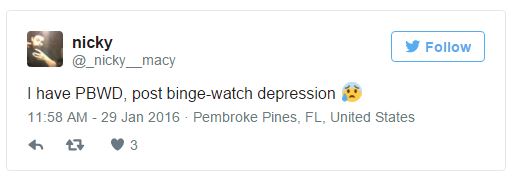
On Twitter, others have expressed similar sentiments.

Are these merely the experiences of a few people who have watched too much TV (and could probably use some fresh air)? Or could binge-watching actually affect your health and well-being?
There’s been limited empirical research on the consequences of binge-watching. So with the advantage of a large sample size, we conducted one of the first forays into studying binge-watching from a public health perspective.
A binge-watching bonanza
According to a survey conducted by the Bureau of Labor Statistics, watching television is one of the most common leisure time activities in the U.S.
On average, Americans spend about 2 hours and 49 minutes per day watching television, and it accounts for more than 50 percent of their daily leisure activities.
Yet the way Americans consume television is rapidly changing, and binge-watching has become a relatively recent phenomenon.
The rising popularity of on-demand streaming services like Netflix and Hulu have made it easier than ever to have uninterrupted access to full TV series, and Collins Dictionary even declared “binge-watch” the word of the year for 2015.
Marketing and social media campaigns have also encouraged binge-watching, with the popular streaming service Netflix calling it the “new normal.”
To date, most of the surveys and research surrounding binge-watching have been conducted by private research firms and companies.
A 2013 survey by Netflix showed that 73 percent of the respondents viewed binge-watching as a socially acceptable behavior. A similar survey by TiVo in 2015 showed that negative perceptions about binge-watching have decreased between 2013 and 2015. About 92 percent of the respondents to the TiVo survey reported that they had binge-watched at some point.
Are binge-watching and mental illness related?
Excessive TV watching has long been associated with health problems. Scientific studies have shown that prolonged television viewing increases the risk of obesity and related diseases such as diabetes.
It’s also been linked to mental health problems like depression. And a recent Texas A&M study revealed that binge-watching is tied to feelings of loneliness and depression. They also found that those who binge-watch lacked the self-regulation to stop, suggesting that binge-watching may be an addictive behavior.
For our study, we surveyed 406 North American adults, recruited from an online data collection platform. We wanted to know more about binge-watchers – particularly their viewing habits, mental health status, and how prevalent and socially acceptable binge-watching was among their friends.
The majority of our respondents defined binge-watching as two to five hours of consecutive video viewing in one day. About 35 percent of the respondents admitted that they binge-watch TV. Not surprisingly, those who self-identified as binge-watchers were more likely to report higher average screen time in the past seven days compared to those who did not identify as binge-watchers. Self-identified binge-watchers were also more likely to report higher addiction to TV (as measured by a validated scale).
The major highlight of our study, however, is that self-identified binge-watchers were more likely to report higher stress, anxiety and depression.
We were ultimately able to demonstrate a relationship between binge-watching, average screen time and mental health status.
However, these results should be interpreted with caution. Our research shows only a correlation and not causation. We don’t know if depression, stress and anxiety are caused by binge-watching, or if it is the other way around. In other words, people might binge-watch as a way to temporarily alleviate preexisting feelings of stress and anxiety.
We also discovered that media influence and social acceptance of binge-watching were found to be significant predictors of self-reported binge-watching.
About 85 percent of the respondents said that they had noticed advertisements or articles encouraging binge-watching, while 74 percent of the respondents reported that they have read articles on binge-watching. An estimated 62 percent of the respondents believed that most people binge-watch and 53 percent of the respondents indicated that most of their friends binge-watch.
Of course, more research is needed to understand the true effects of binge-watching on physical and mental health. In the interim, the next time you load up “House of Cards,” “Jessica Jones” or “Game of Thrones,” it might be a good idea to exercise some caution once the show concludes, and resist the urge to click “next episode.”
 The authors do not work for, consult, own shares in or receive funding from any company or organization that would benefit from this article, and has disclosed no relevant affiliations beyond the academic appointment above.
Monita Karmakar, PhD candidate in Health Education, University of Toledo
This article was originally published on The Conversation. Read the original article.