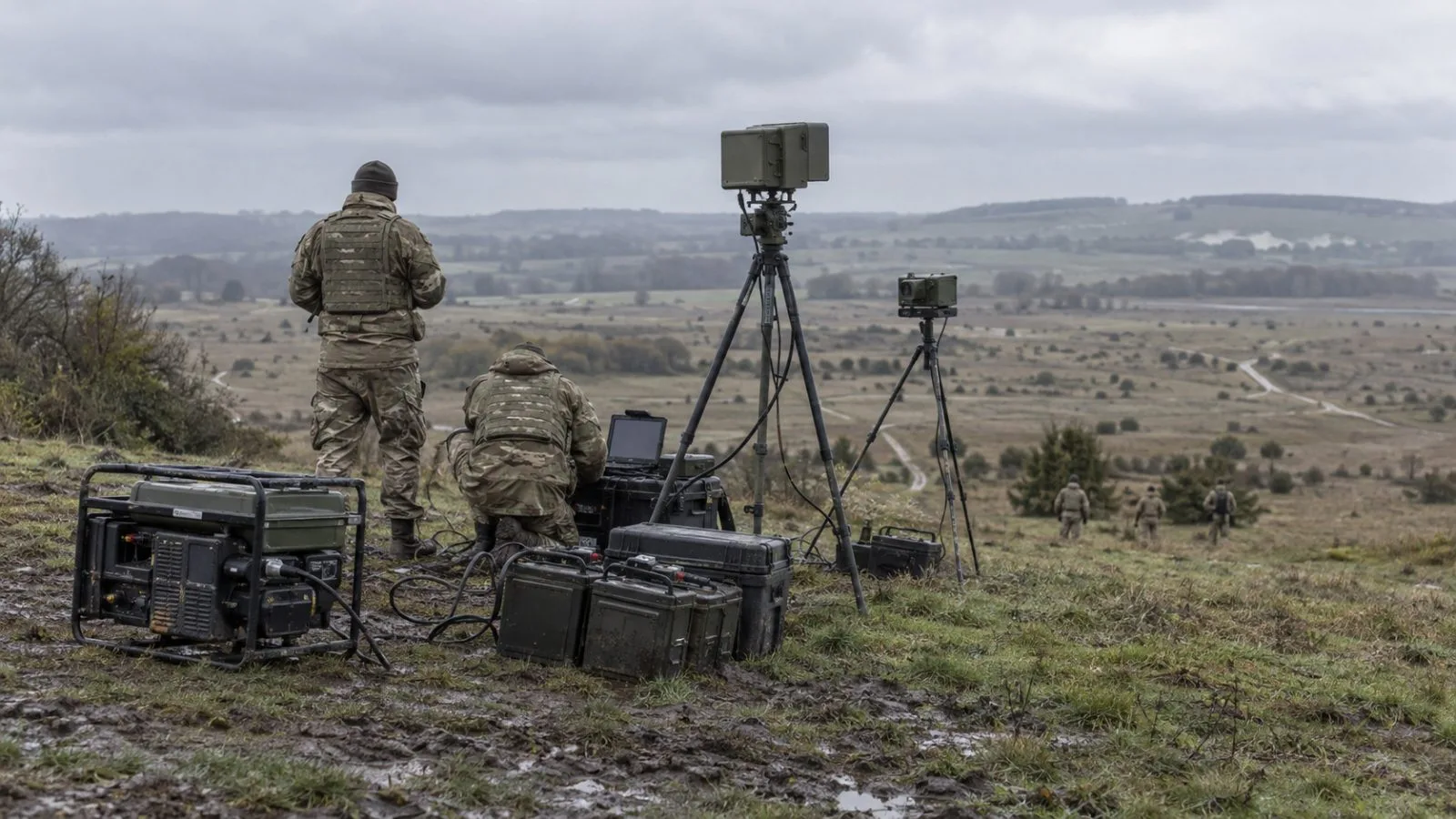
UK Defence Innovation has opened a funded £2.45 million competition track for field power systems on behalf of the British Army, which says growing digital capabilities are raising battlefield electricity needs.
Australia’s Advanced Strategic Capabilities Accelerator (ASCA) is partnering with UKDI on the Tactical Power Challenge, announced Oct. 15; the Defence Science and Technology Laboratory (Dstl) is providing support. It invites proposals to improve how deployed forces obtain electricity and keep it available.
The challenge document ties higher demand to forces spread across wider areas and using capabilities such as Robotic Autonomous Systems, directed-energy weapons, remote sensors and edge computing. It describes current generators as fuel-dependent, difficult to carry and noisy, and says they cannot supply power while moving. The British and Australian armies found during trials that stored energy could require a recovery period of as much as 12 hours after brief use in the field.
The document marks its daily demand figures as indicative: 180 watt-hours for each soldier over 24 hours, 69,000 watt-hours for a platoon of about 30, and 260,000 watt-hours for a company of about 110. Company headquarters accounts for 50,000 watt-hours per day, included in the company total.
The funded “Innovative Tactical Power Solutions” track has £2.45 million available, excluding VAT, to advance technologies from Technology Readiness Level (TRL) 4 to TRL 6. The separate “Immediate Power Problem” track has no funding and is aimed at technologies at TRL 6 or higher with a strong chance of commercialisation within 12 months. The challenge document says solutions of greatest interest in that track may be invited to a demonstration opportunity in the United Kingdom, likely in Warminster, Wiltshire.
The Army identifies a need for a fleet of more than 4,000 Lightweight Field Generators and hopes for substantial procurement in 2027, though rapid buying may fall short of full fleet coverage. Suitable products from the unfunded track could be considered for follow-on procurement. Demonstrations from funded projects are intended to inform the Defence Manoeuvre Power Programme and possible further development; neither route guarantees a purchase.
John Cunningham, Director Innovation responsible for UK Defence Innovation, said, “Reliable and deployable power is fundamental to maintaining operational advantage.” UK submissions may be shared with the Australian government for assessment. Outputs from funded work may be provided to Australian and U.S. government bodies through agreed information-sharing channels.
Applications to both tracks are due by 7 a.m. ET (noon GMT) Nov. 10. The Stage 1 decision is scheduled for Nov. 17, when invited Stage 2 proposals open; those submissions are due Dec. 15. Funded project work must be completed by March 31, 2028.