
The USD/TWD currency pair is anticipated to trade at around 32.2 in the run-up to the United States Inauguration Day, to be held on January 20, 2017. This day is celebrated once in every four years and in the year following the country’s Presidential elections.
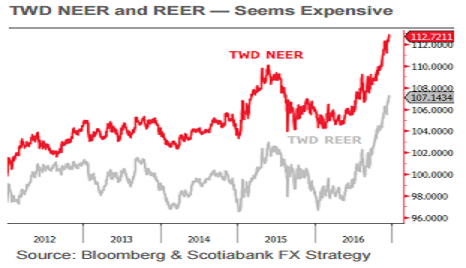
Currently, the TWD remains expensive in terms of either NEER or REER. In the months ahead, the TWD will trade in response to the Fed’s tightening pace, Trump’s protectionist trade policies, potential spillovers of the yuan depreciation and future developments in cross-strait relations, Scotiabank reported.
Potential spillover effects of the yuan depreciation may weaken the TWD, considered a proxy to the yuan. On the campaign trail, Trump vowed to label China as a currency manipulator and impose a 45 percent tariff on imports from China.
Further, geopolitical uncertainty is likely to increase if Trump doesn't moderate his China rhetoric. Cross-strait relations that have cooled but stayed calm so far are less likely to improve in the foreseeable future, which may weigh on the Taiwanese economy.
Also, Trump’s protectionist trade policies will undermine some regional currencies of export-oriented economies such as the TWD.
Meanwhile, USD/TWD traded at 32.00, up 0.12 percent at 7:15GMT.

