
Under 34/55 EMA: Gold Retreats on Trade War Ease, US Claims Dip, Fed Pause Odds Jump
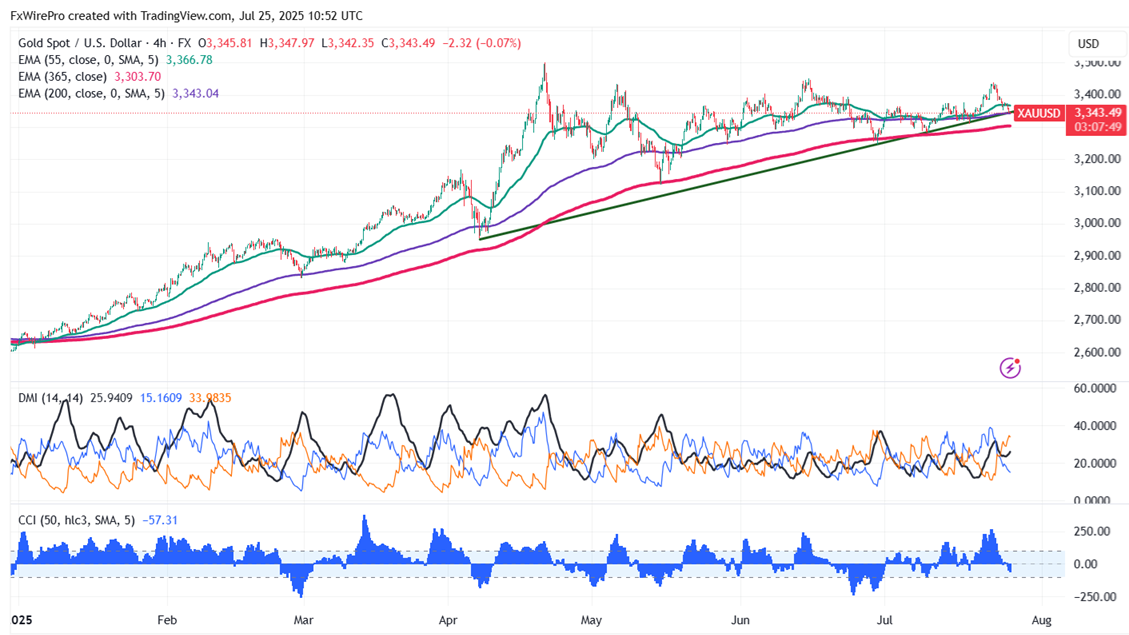
Gold prices pared most of their gains on easing trade war tension. It hits a high of $3438 and is currently trading around $3344.
Comfortably below the 227,000 consensus, U. S. initial jobless claims decreased by 4,000 to 217,000 for the week ended July 19—its sixth straight weekly decrease and the lowest since April 2025—indicating ongoing labor-market resilience despite economic storms. Remaining close to multi-year highs and pointing at milder re-employment even as layoffs remain rare, claims increased from 4,000 to 1,955,000. Reflecting recent departmental cutbacks, federal employee claims rose to 789, their highest in four months. Generally, the figures emphasize consistent hiring, limit employment-related downside risks, and lower the chances of near-Fed rate cuts.
According to the CME Fed Watch tool, the chances of a rate pause in the Jul 30th 2025, meeting have increased to 97.40% from 93.80% a week ago.
Technical Analysis: Key Levels and Trading Strategy
Gold prices are holding below short-term moving averages, 34 EMA and 55 EMA, and above the long-term moving averages (200 EMA) on the 4-hour chart. Immediate support is at $3340, and a break below this level will drag the yellow metal to $3320/$3300/$3295/$3275/$3245. The near-term resistance is at $3360 with potential price targets at $3385/$3400/43420$3450/$3475/$3500/$3550.
It is good to sell on rallies around $3360 with a stop-loss at $3400 for a target price of $3200/$3000.


