


 US Government Moves $1 Billion in Bitcoin Amid Sale Speculation
  Kazakhstan and Tether Explore Tenge Stablecoin and RWA Tokenization
  Zcash Privacy Demand Rises as AI Exposes Bitcoin Transactions
  Dogecoin Liquidations Surge as DOGE Bulls Face Heavy Losses
  Solana Price Drops 3% Despite Samsung USDC Partnership
  Ethereum Price Drops Below $2,600 as Long Liquidations Hit 4-Month High
  Chainlink Price Drops 3% Despite New CCIP Vault Launch
  U.S. Government Moves Over $100M in Bitcoin and BNB
  Jameson Lopp Downplays AI Threat to Bitcoin Cryptography
  DogecoinVM Makes DOGE Transactions 300x Faster
  Cardano Hits Record 436 TPS as Network Scaling Advances
  Litecoin Marks 15 Years as Grayscale Backs LTC ETF Push


 Add as a preferred source on Google
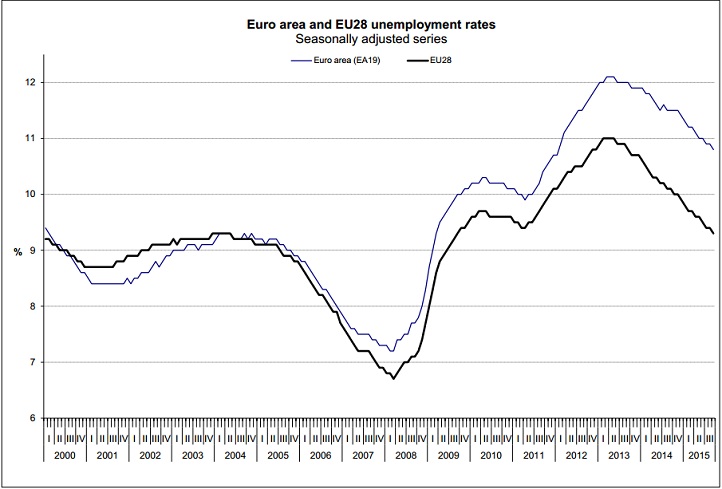
Euro zone unemployment rate dropped to 10.8% in September from 11% a month back. I have been arguing for further ECB action for quite some time, hints of which finally came at last meeting. And key corner piece of my argument has been fragmentation in employment and overall high level of it.
Unlike FED, employment is not a mandate of European Central Bank (ECB) but any sustainable demand driven inflation is not possible to achieve when a large chunk of the workforce doesn't have jobs.
Latest report shows that asset purchase is working with unemployment dropping fast but still not fast enough given the size of the workforce which runs in several millions sitting outside for so long.
ECB sure has the ability to do more given relatively smaller balance sheet size (in value and both % GDP) and inflation relatively low.
Regional employment growth review -
- Fragmentation is diminishing but still at the higher end. While unemployment rate at very low in Germany (4.5%), Malta (5.1%), Austria (5.7%), countries like Greece (25%), Span (21.6%), Cyprus (15.1%) suffering high level of unemployment.
- Moreover for most economies, level of unemployment is quite high - Portugal (12.2%), Italy (11.8%), France (10.7%).
Though Euro zone employment and growth, both headed in right direction, it remains too fragile to withstand headwinds from slowdown in China and debt crisis across emerging markets.
European Central Bank has made the right choice making it my favorite central bank and President Draghi an excellent orator.







