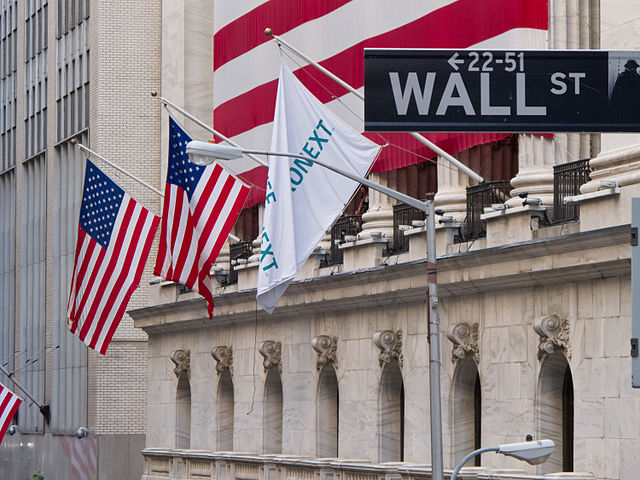
Wall Street closed higher Wednesday as falling U.S. Treasury yields helped offset weakness in technology and semiconductor stocks, while investors assessed Federal Reserve minutes that highlighted persistent inflation concerns.
The S&P 500 rose 0.2% to 7,710.70, while the Nasdaq Composite gained 0.2% to 26,331.09. The Dow Jones Industrial Average also advanced 0.2%, finishing at 53,463.11.
U.S. Treasury yields retreated after the Treasury Department announced plans to double buyback operations for long-dated bonds starting September 9. Buybacks covering the 10-to-30-year maturity range will increase from $2 billion to $4 billion per operation, providing liquidity support to a bond market pressured by inflation worries and heavy corporate debt issuance.
The 30-year Treasury yield dropped about 9.9 basis points to 5.186%, after reaching 5.337% a day earlier, its highest level since 2007. Lower yields offered some relief to equities following concerns that rising borrowing costs could weigh on valuations.
Meanwhile, minutes from the Federal Reserve’s July meeting showed policymakers remained concerned about inflation. Many officials indicated that additional interest rate hikes could become necessary if inflation failed to ease. Officials also viewed inflation risks as tilted to the upside amid continued Middle East tensions and potential supply-chain disruptions.
Oil prices remained elevated as tensions between the U.S. and Iran over the Strait of Hormuz continued. Brent crude climbed 0.4% to around $91.40 per barrel.
Among individual stocks, Marvell Technology surged nearly 10% after announcing an expanded agreement with Alphabet’s Google to develop custom silicon for artificial intelligence applications. Stifel estimated the partnership could generate as much as $120 billion in cumulative revenue over roughly six-and-a-half years.
Moderna soared about 177% after its experimental mRNA melanoma treatment, developed with Merck and combined with Keytruda, succeeded in a late-stage trial. Merck gained 12.6%.
In retail, Lowe’s rose 2.3% despite lowering its annual sales outlook, while Target jumped 4.3% after raising its full-year sales forecast for the second consecutive quarter.