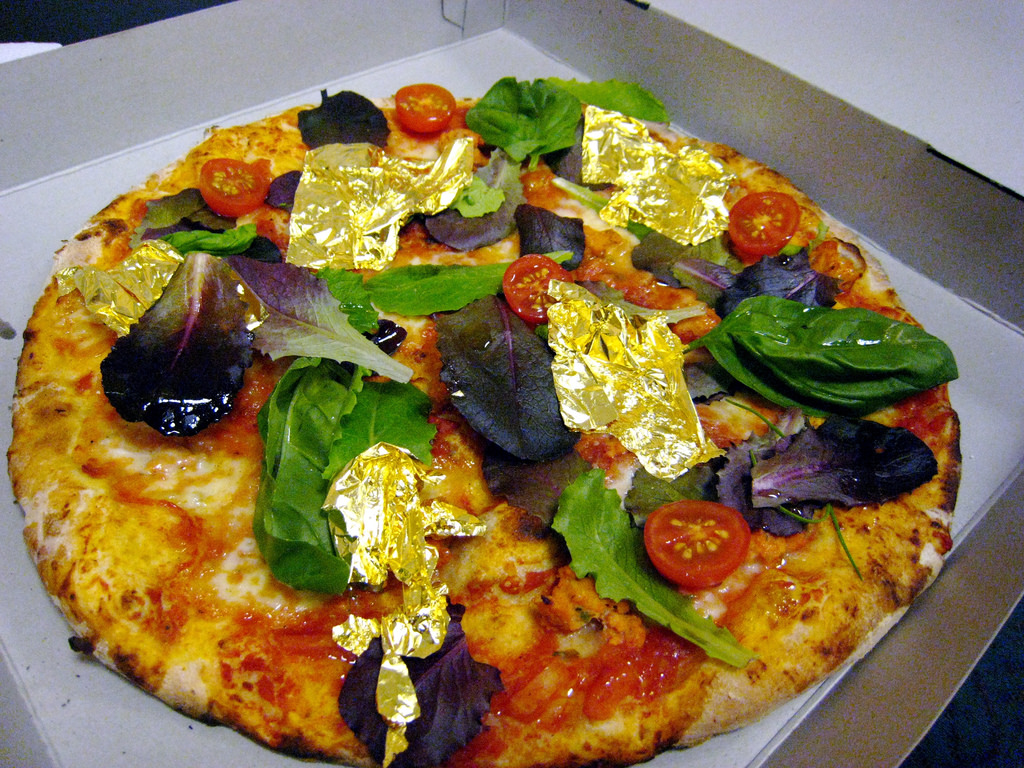
A restaurant in the New York financial district is offering customers a pizza priced at US$2,000 (£1,623). It is topped with caviar, stilton cheese and gold leaf, with each bite costing around US$50.
New York is usually the kind of place that sets trends, but pizzerias elsewhere have actually been making pizzas sparkle for a while. A takeaway pizza chain in London started offering £500 pizzas a year ago, this time topped with lobster, caviar and truffle oil; while a Glasgow restaurant attracted attention by selling a gold leaf pizza on eBay.
Gold on food goes back a good deal further than that, however. The renowned Italian chef, Gualtiero Marchesi, has been topping his signature dish, risotto alla milanese, with a single leaf of gold for decades. And that too is recent when you reflect that the kitchens of the wealthy were sprinkling the precious metal on feast cuisine during medieval times.
There is a medieval liqueur still consumed today with gold flakes in it known as Goldwasser. Gold leaf is also used on chocolates and even has an E number (E175). Whatever else has changed over the years, swallowing gold has always been considered the highest form of decadence. But what happens when we put gold into the body? And are there any other metals we’d be better off shaving on to pizzas instead?
Eat your carats
Gold is an inert metal and is therefore not degraded by the acid in our stomachs. It will travel the length of the intestinal system unchanged, passing out in your poo. Depending on the sewage treatment system, it will eventually be returned to the land or washed out to sea ready to be recycled again. It casts panning for gold in an entirely new light.
Other metals are generally not used for ostentatious displays of edible wealth, but one exception is silver. Silver can be beaten into a leaf similar to gold and is also approved for use as an additive (E174) – so long as it is pure and in its non-ionic form, which is the one that can’t be absorbed by the body.
Even then it is easier to add other metals to silver than gold, so there is still the risk it can be contaminated with the likes of aluminium. This can reduce the body’s ability to absorb essential minerals such as zinc, calcium and iron (aluminium is not essential). This will cause deficiency symptoms as diverse as soft bones (calcium), tiredness (iron) and lack of smell (zinc).
You might think these minerals might therefore be just the thing for a pizza, so long as they are in the ionic form that the body needs. We tend not to notice them in our diet but they are ubiquitous in grains, fruit and vegetables as they are essential for plant growth, too. Meat and dairy products are particularly rich sources and we have a very efficient system of absorbing the minerals they contain.
One reason we don’t see minerals grated on our foods, of course, is that they don’t give the same bling value. But they will also react with the acid in our stomachs and get absorbed, since they are not inert. Excessive amounts of minerals in the body can be toxic, since they get laid down in soft tissues such as the brain and kidneys. This causes severe pain and eventually death.
In normal circumstances the body avoids such horrors by only absorbing a percentage of the minerals in the foods we eat. But if you flood the system with a mineral by taking large quantities, it can cause an excessive intake. As well as the toxicity risk, excessive intake of one essential mineral can make the body struggle to properly absorb other essential minerals – the same risk as when you ingest non-essential minerals like aluminium.
The bottom line is about balance, as with most of nutrition. Since there’s plenty of these minerals in the foods we eat, there’s absolutely no need and much potential harm to be had from adding any extra to our meals – or from taking supplements we don’t need.
Better to stick to gold, which does nothing good or bad for health except perhaps a feeling of satisfaction – or regret if you see it twinkling as it disappears down the drain. And if you’ve more money than sense and you’re still hungry for more after that gold pizza, you could always ask your willing chef to throw in a few diamonds next time. They’re inert, too, albeit a little crunchy.
 Marie-Ann Ha does not work for, consult, own shares in or receive funding from any company or organisation that would benefit from this article, and has disclosed no relevant affiliations beyond the academic appointment above.
This article was originally published on The Conversation. Read the original article.