


 Hyperliquid Top Traders Turn Bearish as Smaller Wallets Stay Bullish
  DeepSeek, Huawei Partner on Ascend AI Chip Programming Tools
  Wall Street Edges Higher as Treasury Yields Retreat
  Asian Currencies Mixed as Yen Slides on BOJ Rate Signals
  Fed’s Logan Signals 50 Basis Points More in Rate Hikes
  TD Cowen Starts SpaceX at Buy, Sees AI Compute Driving Growth
  Trump, Tech Leaders Sign ‘Morally Binding’ AI Safety Accord
  DogeOS Launches Testnet to Bring DeFi Apps to Dogecoin
  Citi Raises Bitcoin Price Target to $113,000 on ETF Optimism
  AI Agents Could Disrupt Financial Services, Bernstein Says
  WordPress Malware Uses Ethereum to Evade Removal
  Oil Prices Steady as Middle East Crude Flows Recover
  Middle East Oil Exports Recover as Tanker Costs Surge
  Robinhood Launches AI Agents for Automated Trading
  Amazon Eyes $8 Billion Nvidia Chip Spinoff to Fund AI Expansion
  Gold Prices Slip as High Treasury Yields Weigh on Bullion
  Evernorth Set for Nasdaq Debut With 473 Million XRP Treasury


 Add as a preferred source on Google

Which company would you say is going to grow faster in the coming years: Apple or Domino’s Pizza? Intuitively, we see Apple as an innovative firm with a forward-looking culture and disruptive ideas, while Domino’s Pizza operates in a traditional sector where growth opportunities are limited. Ask a recent MBA graduate whether she would rather accept a job offer from either company and I bet I can predict the answer with 99% confidence.
In the past ten years, Apple’s stock market performance has been outstanding. On an annual basis, the stock has been delivering returns of 32%, so that US$100 invested on November 2008 is worth US$1,640 today. Not bad.
But in the past two months Apple shares have lost more than quarter of their value. This is partly due to its own performance, but primarily down to the scrutiny that regulators and society in general are putting on digital platforms and concerns about privacy and security. More broadly, however, it is reflective of the fact that Apple should no longer be considered an innovative growth company.
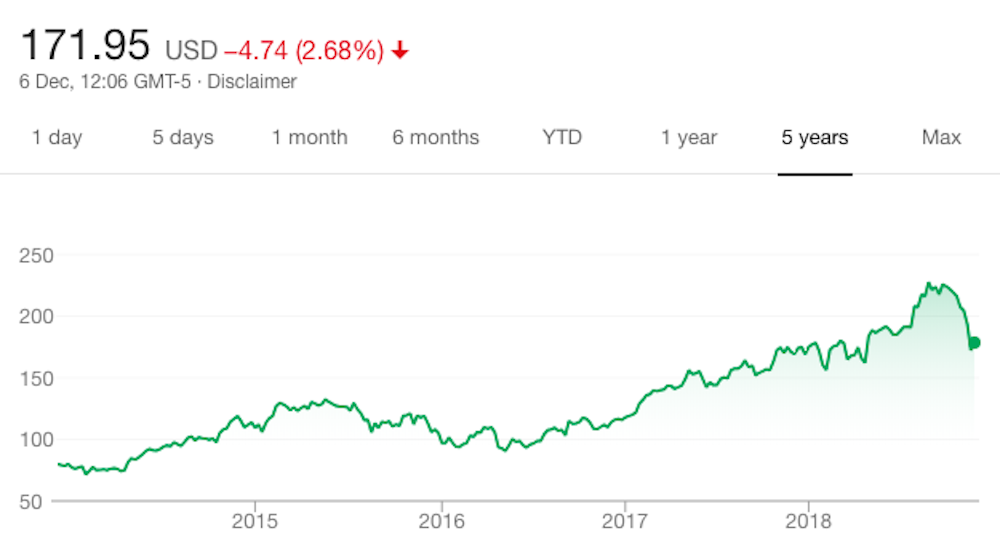
Apple’s share price in the last five years. Google
Apple’s growth over the past decade (and the stock performance that accompanied it) is a reflection of its profitable operations. In the past year, Apple reported a net profit margin of 22.4%. This compares to a meagre 10.6% for Domino’s Pizza. At the end of the day, pizza is a consumer-goods product that is hard to sell at a premium and sits in a very competitive market, while Apple sells technology and enjoys a position of relative market dominance.
Look more closely at Apple’s recent performance on the stock market, however, and you can see that it has delivered a meagre 4.5% return since January 1 this year. Between 2000 and 2010, its average annual stock return was about 55% per year (despite the financial crisis), and between 2010 and 2017 its stock has delivered about 24% per year on average.
As a growth company, Apple is expected to generate value and profits – not today, but in the future, because it is innovative. The inability to deliver immediate results means that growth stocks do not pay dividends. Instead, investors expect the stock price to go up when earnings come. This gives Apple a high price-to-earnings ratio, which measures both the ability of a company to generate growth (as a multiple of its current earnings), as well as how expensive a share is – the more investors pay for it, the more they think their earnings will grow in the future.
And so growth companies tend to be expensive for two reasons: they do not generate earnings, and the market is willing to pay a high premium on future value. Currently, industries such as pharma, technology, biotech and software are growth sectors.
In contrast, value stocks (“blue chips”) are those that trade at relatively lower multiples, but which generate high value and profitability today – and hence higher dividends. In today’s markets, tobacco, airlines and life insurance stocks are blue chips.
Ask the market
The beauty of markets is that they reflect the future opportunities of firms in an accurate way, after consolidating the opinion of millions of investors. Today, Amazon’s price-to-earnings (PE) ratio is around 90. For the average stock in the average year (over the past century), the PE ratio is 15.
Amazon’s valuation reflects the market perception that the company is going to deliver extraordinary results in the future – and that, although it is profitable today, most of its value is yet to be delivered. By contrast, British American Tobacco is trading at a PE ratio of around 2, and is, not surprisingly, one of highest dividend-paying stocks in the market, rewarding its shareholders on a more frequent basis.
Markets give an important insight into what a company’s future will hold. Innovations are only judged after the fact – once they succeed or fail – and history does not recognise those innovations that were not successfully adopted by customers. Remember the laserdisc?
Pizza delivery
Today, out of Apple and Domino’s Pizza, the one with greater growth opportunities is actually Domino’s, according to the market. In fact, Apple should now be considered a blue chip, a stock with unclear growth opportunities, as it is currently trading at a PE ratio of around 15. Domino’s, by contrast, is trading at a PE ratio of around 30.
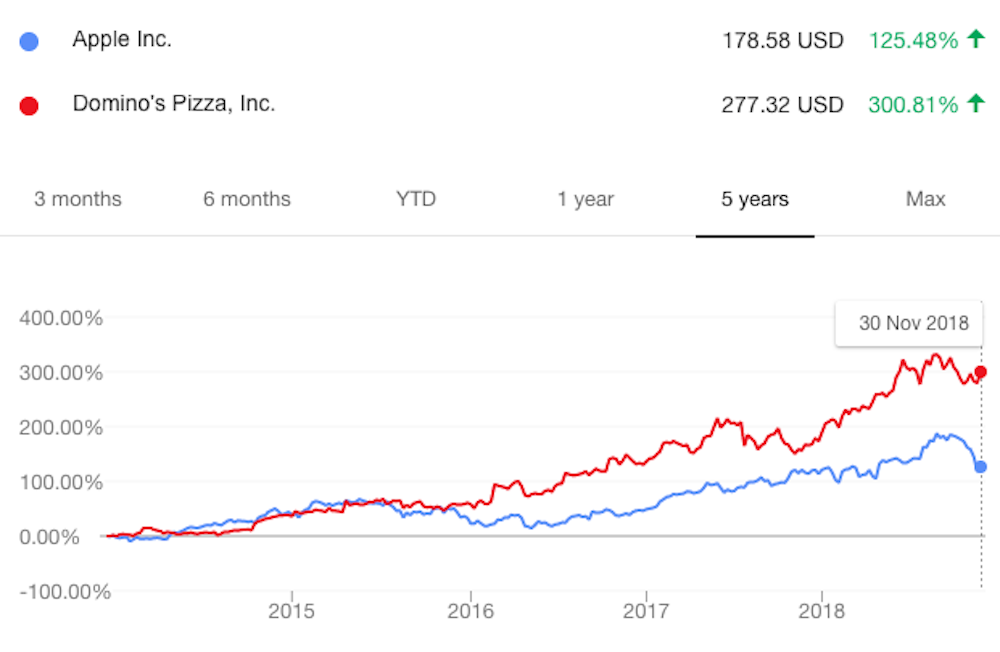
Apple stock vs Domino’s Pizza stock. Google
More interestingly, since May 2010, Apple’s valuation has halved on an earnings basis, which signifies that the company has naturally made a transition from a growth company to a value stock. If I had to bet on the future of either company, I would for sure say that a pizza company will deliver more value to its shareholders than Apple – not least because the fast-food industry is exploding in China.
Investors have money at stake and this self-interest drives the market fundamentals which reflect a company’s long-term, future success. So if you want an insight into a company’s future, the markets are the best place to look.







