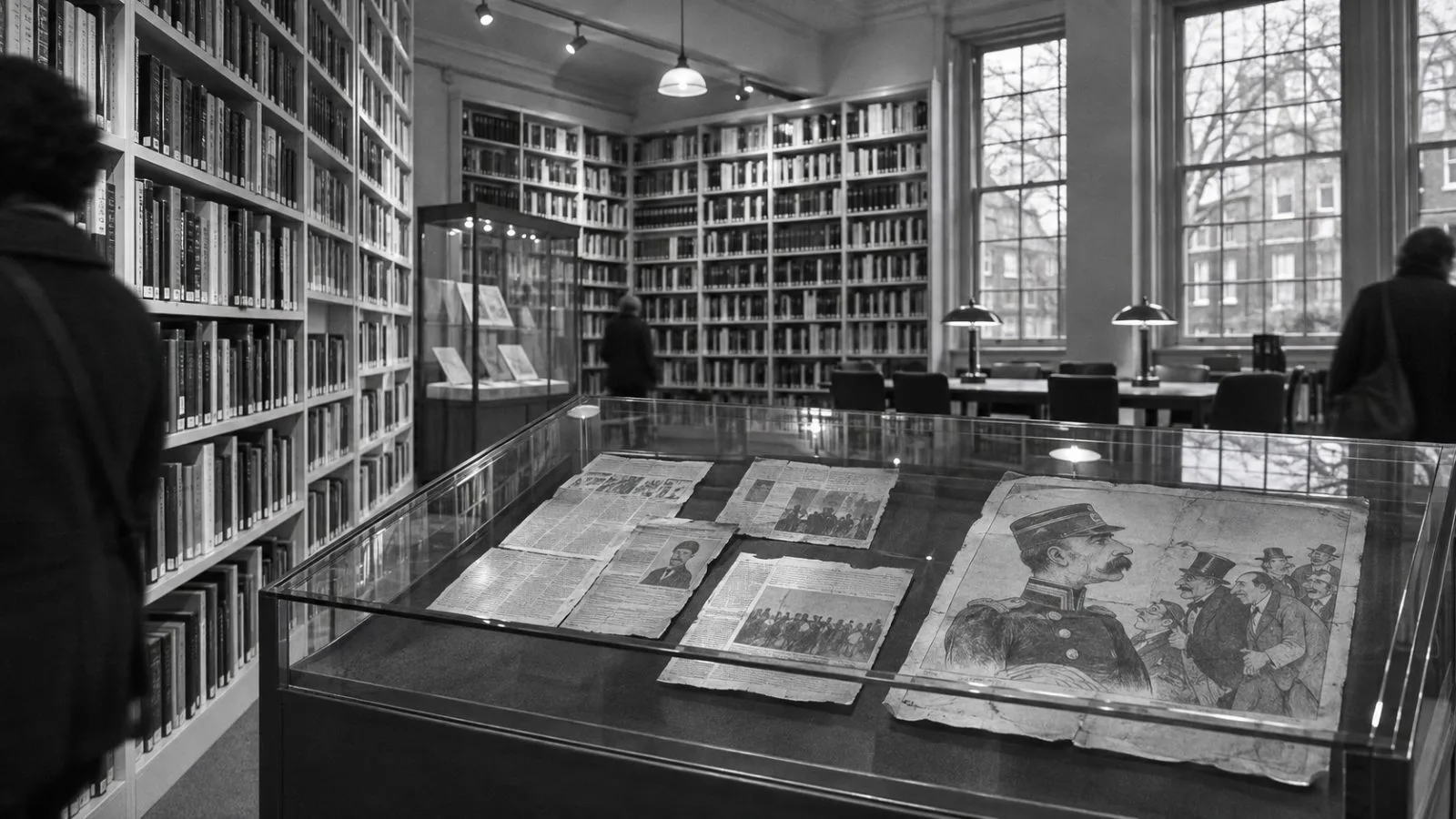
The Wiener Holocaust Library in London is using newspapers, posters and archival documents to revisit how the Dreyfus affair became a mass public debate over a Jewish French Army officer.
The exhibition, “J’accuse! Press, Polemic and the Dreyfus Affair,” draws on documents, press cuttings and posters in the Library’s archive. Its focus is the printed record of the dispute over Alfred Dreyfus and the public figures who defended him. The Library frames the affair as an early instance of antisemitic conspiracy claims reaching broad audiences through mass media.
The French National Archives says Dreyfus was convicted of treason on Dec. 22, 1894, after the prosecution relied partly on a secret file the defense had not seen. The Court of Cassation set aside that verdict in 1899, and a new military trial resulted in another conviction. Dreyfus was pardoned on Sept. 19, 1899, but the pardon did not clear him. On July 12, 1906, the court annulled the later conviction, finding the accusation unjustified.
The French Ministry of Culture says the July 29, 1881, press law made printing and the book trade free. It also allowed periodicals to be issued without prior declaration or authorization.
The Guardian reported that the exhibition displays about 40 items, including material collected by Alfred Wiener, later Library acquisitions and a long-term loan from Birkbeck, University of London. Library co-director Barbara Warnock used the phrase “gone viral” to describe the spread of antisemitism during the affair, The Guardian reported.
The Guardian also reported that exhibition curator Clara Dijkstra said the Musée des Horreurs series depicted prominent Dreyfus supporters and appeared in 45 to 50 versions from autumn 1899 through 1900.
The Library lists the exhibition through March 19, 2027, and has scheduled a talk with historian Kevin Passmore for Dec. 3, 2026.