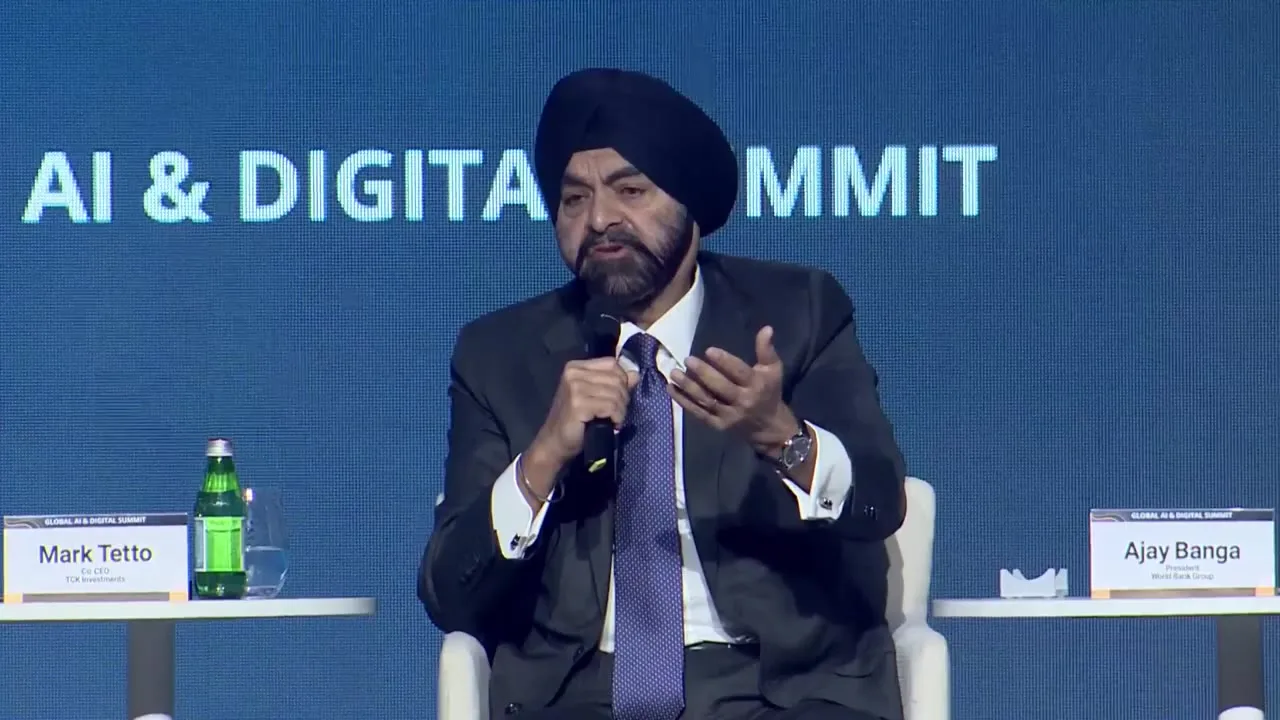
The World Bank Group mobilised $112 billion in private capital last year to support its shift towards creating jobs, its president, Ajay Banga, said at a summit in Seoul.
That compared with $32 billion three years earlier, Banga said. He linked the shift to strained government budgets and the need to create opportunities for young people.
Banga spoke at the Global AI & Digital Summit in an interview published by the World Bank Group on Oct. 21. He outlined the institution's own approach to financing development and expanding access to digital services.
Public resources face constraints in almost every country, while development needs run into trillions of dollars, he said. He also cited 1.2 billion people in developing countries who will turn 18, without specifying a timeframe.
“Poverty is both a state of being and a state of mind,” Banga said. Financial support can address material needs, but people also need the opportunity to work and contribute to their families and society, he said.
He described an approach combining public finance, philanthropy, private investment and technology. Governments remain essential to funding roads, electricity, schools and healthcare during the early stages of development, he said.
Philanthropic organisations can fund work that governments and businesses cannot, Banga said. He cited cooperation with the Rockefeller Foundation in Africa and the Gates Foundation on adapting simple artificial intelligence tools to local languages.
The institution put $120 billion from its own balance sheet to work last year, Banga said. It has also launched a philanthropy hub to connect donors with organisations that could use their funding.
Infrastructure and good governance must come before private investment can help create jobs, he said. He identified farming, primary healthcare, tourism, manufacturing and entrepreneurship as areas where countries could generate employment.
Digital services can lower barriers that protect established businesses and give newcomers access to markets, Banga said. He described their role as helping people with ideas reach opportunities previously beyond their grasp.
But access remains limited. Some 2.2 billion people lack internet access or do not use it, and 95% are in lower- and middle-income countries, Banga said.
Electricity must come first, he said, citing 600 million people in Africa without it. Households need enough affordable, reliable power to run businesses and computers, alongside internet cables and mobile towers, he said.
“The fundamentals are really important,” Banga said.
Affordability is another obstacle, including the cost of devices, service plans and taxes, he said. He used a hypothetical $20 monthly digital plan carrying a $2 tax to illustrate the burden on poorer users.
Wealthier customers could afford that tax, while lower-income customers could lose access to services that help them enter markets, he said. Governments need revenue but should consider how such charges affect access.
Banga then described women farmers in India's Uttar Pradesh using tools developed with Google and other partners on older third-generation mobile phones. They could ask questions aloud and photograph leaves to identify plant diseases and possible treatments, he said.
He gave no timetable for closing the internet access gap or targets for reducing the costs he described.