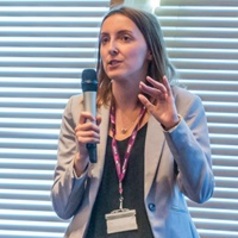
Senior Lecturer in Psychology, Liverpool Hope University Jamie Lingwood is a Senior Lecturer in Psychology at Liverpool Hope University. His research focuses on how adult-child interactions influence language development and learning, including from digital media. He is the Principal Investigator on an Educational Endowment Foundation-funded project, designing and evaluating an innovative program to inspire and sustain a love of reading in children. Jamie was an on-screen expert for the BBC's Tiny Happy People Campaign, where he used his expertise to help parents support their children's language and communication skills.
Research Fellow in Microbial Evolution, Manchester University I am a Wellcome Trust Research Fellow in Microbial Evolution Research Manchster (MERman) and the Manchester Fungal Infection Group (MFIG, http://www.inflammation-repair.manchester.ac.uk/mfig). My main research interests are: One Health and Fungal infections, Antimicrobial Resistance (AMR), Climate change and Genetic tools in non-model organisms (Fungal pathogens) I started my Research career at the University of Manchester obtaining my PhD. This project was focused on transcriptional regulation during Aspergillus fumigatus infection of the mammalian lung through high-throughput screening of mutants. As an example, we screened the library for azole sensitivity and resistance where my passion for AMR came from. During my PhD project we have developed CRISPR methodologies for genome editing of A. fumigatus. The focus was on CRISPR-mediated protein tagging and point mutations to avoid using dominant selection markers during transformation. This methodology is widely adopted now in several research laboratories and is still driving much of my research. I am currently working on a project linking climate change to antifungal resistance, working on dual-use fungicides and novel antifungals. I work on evolution in soil through various techniques combining environmental microbiology, molecular fungal biology and infection biology.
Associate Professor in Popular Fiction, University of Birmingham My research interests lie in popular fiction (especially romance). I am interested in genre fiction, publishing, women’s writing, gender, sexuality, ethnicity, and migration. I have published research on: * contemporary women’s historical fiction * sexualisation and women’s advice literature * medieval and modern literary representations of virginity * class and wealth in popular romance fiction * chick lit from the Middle East * imperialism in the medieval romance Emaré * Scottish popular romance in the twentieth century * migration fiction. I have edited special issues on E. M. Hull's early twentieth-century classic novel, The Sheik, multi-disciplinary approaches to critical love studies, and medieval romance, gender and materiality. My first book, Representing Difference in the Medieval and Modern Orientalist Romance (Palgrave, 2016) is a comparative study of Orientalism in medieval and modern popular romance and compares the representation of erotic relationships across religious and cultural borders in late medieval Orientalist romance (1330-1450) and British and North American post 9/11 romantic fiction. I m Principal Investigator for the AHRC-funded Muslim Women's Popular Fiction research network: https://more.bham.ac.uk/mwpf-network/ I am the Managing Editor of the Journal of Popular Romance Studies: https://www.jprstudies.org/
Teaching Professor of Psychology, Penn State My areas of specialty include infant, child, and adolescent development and child psychopathology. I have special interests in behavioral therapy, peer relationships, and neurodiversity with a specific focus on the Autism Spectrum. I have been lucky to teach a variety of courses over my career surrounding these topics and look forward each semester to updating course materials with the newest scientific breakthroughs in our understanding of human development and mental health. Working with my students has been the greatest joy of my career. Every class is an opportunity to connect with the amazing people in my classes. There is no other job like it! In my spare time, I volunteer as a firefighter with ALPHA Fire Company. I also write psychological thrillers under the pen name Sarah K. Stephens. When I’m not teaching, volunteering, or writing, I’m enjoying time with my husband and family in the wilds of Central PA.
Associate Professor in Computing, Edinburgh Napier University Dimitra Gkatzia is an Associate Professor at the School of Computing at Edinburgh Napier University. She is interested in the evaluation of Natural Language Generation systems, and data-driven Natural Language Generation (NLG) for low-resource domains/languages. More recently, Dimitra has been interested in exploring privacy issues in LLMs and exploring how we can use them responsibly. Since 2021, Dimitra is the co-lead of the SICSA (Scottish Informatics and Computer Science Alliance) AI Theme. Between 2016-2020, Dimitra served as an elected member of the Steering Board of the Special Interest Group in Natural Language Generation (SIGGEN). At Edinburgh Napier, Dimitra is currently leading the Natural Language Processing Group.
Head of Creative Writing, University of Portsmouth I’m the Course Leader for many of the undergraduate creative writing courses at the University: BA (Hons) Creative Writing; BA (Hons) English and Creative Writing; and BA (Hons) Film Studies and Creative Writing. I also teach on MA Creative Writing, and am the Academic Lead (Communication) alongside Journalism lecturer Ian Tapster. My PhD explored where writers get their ideas from, researching the complete history of writers back to the routes of Greek mythology and the nine muses. I believe that poetry and prose can have a powerful impact on civic wellbeing. Through my recent research, I’ve looked at how people who suffer dementia can remember lyrics, giving the writer an opportunity to use beats and rhythm creating ways to connect. The rhythm of poems can stick in one’s mind and this creative form can also be used to translate vital messages to improve public health. From outreach work with schools and colleges, I’ve learnt that the same imaginative tasks I give undergraduates in class can also bring mental focus and calming structure to younger children. Communities can learn via negative memories, through the process of telling stories and ‘narrative therapy’, allowing a person to reflect on their experience and revealing how they survived. I lead the Portsmouth Writers Hub, a new community interest company (CIC) that brings many University writers and writing groups together such as: Vincent Adams William Sutton Tom Sykes (Star & Crescent) Amanda Garrie (T’Articulation) Tongues and Grooves Havant Writers Circle Lovedean Writers Work from the Hub aligns with the University’s democratic citizenship research theme, with members working on homeless, bereavement, addiction and environmental projects. We also have links with Bookfest and Darkfest plus local theatres and libraries too. My students are always invited to participate in community events, and have already contributed articles for Star & Crescent, Portsmouth’s independent news website. With my passion for literature and connecting with others in a public-facing role, I’ve collaborated with local writers, colleagues, alumni, and environmental activists – Friends of the Earth, Plastic-Free Portsmouth and Extinction Rebellion – for Pens of the Earth, a project that aims to change people’s behaviour towards the environment. An example is the Streets for People initiative, rethinking the way our streets are used. With the support of partners, a street in Portsmouth closed for a day, allowing neighbours to connect in new ways and for children to play safely whilst air quality improves.