


 Indian Refiners Scale Back Russian Oil Imports as U.S.-India Trade Deal Advances
  Trump’s Inflation Claims Clash With Voters’ Cost-of-Living Reality
  Yen Slides as Japan Election Boosts Fiscal Stimulus Expectations
  U.S. Stock Futures Rise as Markets Brace for Jobs and Inflation Data
  South Africa Eyes ECB Repo Lines as Inflation Eases and Rate Cuts Loom
  Dow Hits 50,000 as U.S. Stocks Stage Strong Rebound Amid AI Volatility
  Lee Seung-heon Signals Caution on Rate Hikes, Supports Higher Property Taxes to Cool Korea’s Housing Market
  Asian Currencies Stay Rangebound as Yen Firms on Intervention Talk
  U.S.-India Trade Framework Signals Major Shift in Tariffs, Energy, and Supply Chains
  China Extends Gold Buying Streak as Reserves Surge Despite Volatile Prices
  Japan Economy Poised for Q4 2025 Growth as Investment and Consumption Hold Firm
  Trump Signs Executive Order Threatening 25% Tariffs on Countries Trading With Iran
  Russian Stocks End Mixed as MOEX Index Closes Flat Amid Commodity Strength
  Vietnam’s Trade Surplus With US Jumps as Exports Surge and China Imports Hit Record
  India–U.S. Interim Trade Pact Cuts Auto Tariffs but Leaves Tesla Out



The government has widely touted its support for small businesses – most notably the provision of loans subsidised by the Reserve Bank.
In its economic update on Friday the Reserve Bank talked up its low-cost Term Funding Facility. Take-up was “increasing steadily”.
The scheme gives banks ultra low-interest money (0.25% per year for three years) on the understanding they will lend it to households and businesses that need it.
The first allocation was a proportion of each lenders’ loan book. The second was conditional on the the lender expanding lending to business.
For every extra dollar the bank extended to large business, it would get one extra dollar of funding from the Reserve Bank. For every extra dollar it lent to a small or medium size business it would get an extra five dollars.
Yet the official figures suggest that the overwhelming bulk of the new money has gone to big businesses, those with turnovers of more than A$50 million per year.
Medium-sized businesses have barely got a look-in. Lending to small businesses has actually gone backwards.
Outstanding credit to businesses
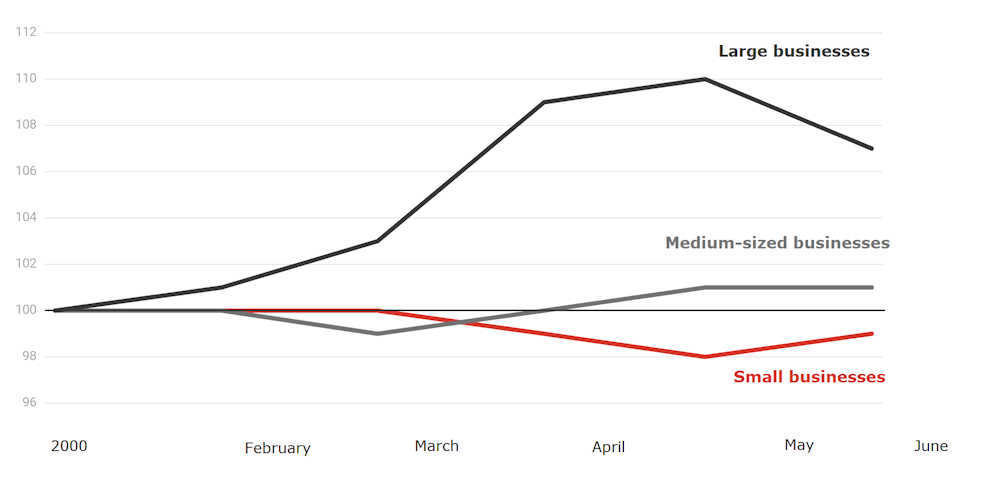
Index. 100 = January 1, 2020. Reserve Bank of Australia
Loans outstanding for big businesses are 7.4% higher than at the start of the year, loans outstanding for medium-sized businesses are just 1.3% higher, and loans outstanding for small businesses are down 0.6%.
Not only have banks channelled the overwhelming bulk of their new lending to large businesses, they have also done so at lower interest rates.
Credit spread reductions for businesses
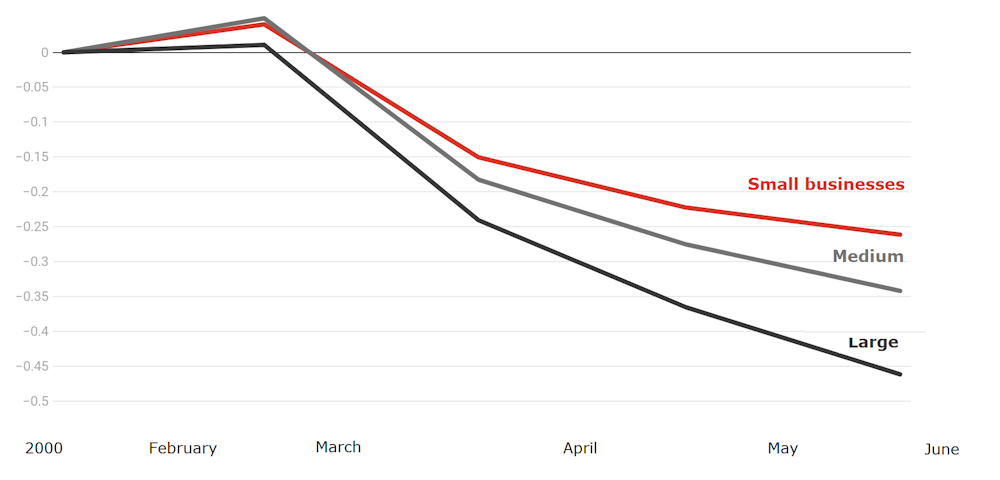
Percentage point change in spread between cash rate and rate charged from February 1, 2020. APRA
Why have small businesses missed out? One explanation might be that they are not interested in borrowing.
However, ask any economist, and she will tell you that demand for a good is usually a function of its price.
This ought to be also be true for business credit. The Reserve Bank says small businesses are being charged as much as 4.5%.
If the interest rate was lower there is a fair chance the amount borrowed would rise.
Banks don’t think they’re worth the risk
Another explanation might be that banks don’t see much profit in lending to small businesses. Start ups are risky, even more so in a recession. But the Term Funding Facility was specifically set up to counter this.
Unfortunately it has proved inadequate to the task. The Reserve Bank’s offer of a three year loan fixed at 0.25% has not been generous enough to appeal to a banking sector whose cost of funding from traditional sources has also plunged.
What can it do to re-calibrate the Term Funding Facility? It is is due to expire in January and will need to be extended in one form or another.
They might if the money was free
One solution would be to take a leaf out of Europe’s book and make the interest rate on part of the next phase of the program negative, essentially free money.
The European Central Bank’s scheme offers loans at rates as low as -1% to banks that are willing to expand lending to small and medium-sized businesses.
This offer has helped drive the interest rate faced by small and medium-sized businesses as low as 2%, well below the 4.5% sometimes charged in Australia.
If the Reserve Bank offered part of the Term Funding Facility at a negative interest rate for banks that expanded lending to small businesses, it would likely see some expansion.
It would both help stimulate the economy and increasing financial stability by making small business failures less likely.
Some might argue against this by saying that negative interest rates are unprecedented in Australia. But this argument does not hold water.
The times, and almost every proposed solution to our current problems, are unprecedented too.













