


 CDC Monitors 41 Americans After Andes Hantavirus Outbreak on Luxury Cruise Ship
  US Judge Seeks Explanation for DOJ’s Decision to Drop Gautam Adani Bribery Case
  US Plans Kenya Ebola Quarantine Facility Amid Congo Outbreak
  Oppenheimer Sees CNH Industrial as Top 2026 Agriculture Stock Pick on Dealer Consolidation Strategy
  New Mexico AG Accuses DOJ of Delaying Jeffrey Epstein Ranch Investigation
  DOJ Subpoenas New York Times Journalists Over Air Force One Leak Report
  Genesis Minerals to Acquire Vault in A$5.6 Billion Deal After Regis Withdraws
  Trump Administration Sues Maryland Over Alleged Sanctuary Immigration Policies
  JPMorgan Cuts Gold Price Forecast, Sees Bullion Reaching $4,500 by End of 2026
  ICC Says Darfur War Crimes Probe Reaches Breakthrough in Sudan Investigation
  Takeda Hit With $885M Verdict Over Amitiza Generic Drug Delay Scheme
  Goldman Sachs Flags 3 Key Risks Ahead of Europe’s Earnings Season
  OpenAI Executive Fidji Simo to Step Down Amid Health Challenges Ahead of IPO
  Paramount-Warner Bros. Discovery Merger Faces Lawsuit From 12 States
  In a rebuke to Trump, the Supreme Court rules that birthright citizenship is the law of the land





A United States congressional report revealed last year that five opioid manufacturers made more than $10 million in payments to patient advocacy groups and professional societies between 2012 and 2017.
Initiatives from these advocacy groups and professional societies often echoed and amplified recommendations to increase opioid use. For example, they promoted opioid for chronic pain, minimized the risk of addiction and criticized the Center of Disease Control and Prevention (CDC) guidelines to limit opioid prescriptions.
In addition, opioid manufacturers used these groups to lobby Congress to change laws directed at curbing opioid use. This, according to the report, “may have played a significant role in creating the necessary conditions for the U.S. opioid epidemic.”
Patient advocacy groups play an important role in democratic societies, giving voice to vulnerable populations, shaping health policy debates and acting to influence public policies to promote their members’ interests and needs.
When funded by the industry, however, they often serve merely as a marketing tool — promoting corporate interest.
To date, there has been no attempt to systematically investigate the relationships between opioid manufacturers and pain advocacy groups and societies in Canada. However, evidence shows that, similar to the U.S., opioid manufacturers fund such organizations in Canada.
Advocacy groups echo corporate interest
In Health Advocacy Group Inc: How Pharmaceutical Funding Changed the Breast Cancer Movement, bioethicist Sharon Batt explores the alliance between patient-group advocacy and pharmaceutical companies in Canada. She suggests that this relationship can distort policies that have been put in place to protect public health.
Batt questions the ability of such groups to speak on behalf of people who need help, and shows how advocacy groups today echo the demands of pharmaceutical companies that are often counter to its members interests.
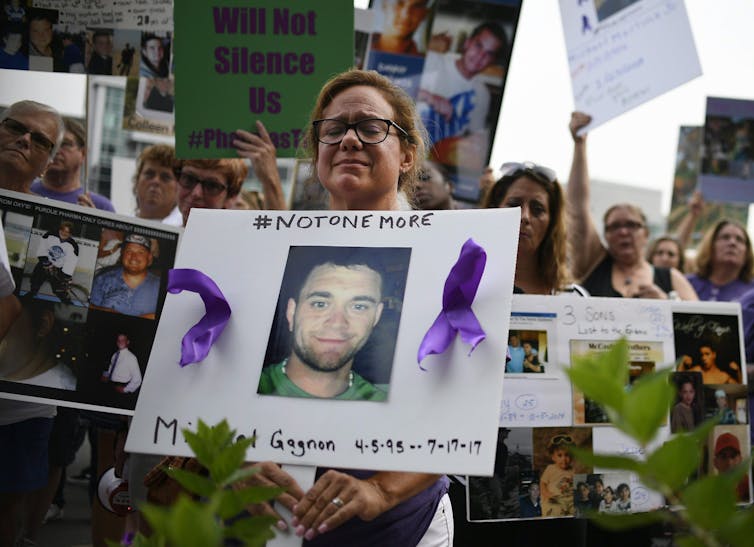
Christine Gagnon of Southington, Conn. protests with other family and friends who have lost loved ones to OxyContin and Opioid overdoses at Purdue Pharma LLP headquarters in Stamford, Conn., Aug. 17, 2018. (AP Photo/Jessica Hill)
For example, in 2005 the Canadian Pain Society arranged a pain management event, supported by an unrestricted educational grant from Purdue Pharma Canada, the manufacturer of OxyContin. A conference held by the same society in 2007 included a Purdue Pharma symposium.
In another case, the Chronic Pain Association of Canada received money from Eli Lilly Canada Inc., Purdue Canada Inc. and Merck Frosst Canada.
A blog post on the association’s website contains messages favourable to increased opioid use and criticizes arguments questioning opioid effectiveness, calling it “anti-opioid hysteria and propaganda” caused by prominent “anti-opioid activists.”
Two years ago, Purdue donated just shy of $1 million to Canadian health-care organizations, some of which could have been patient groups. (The way the information is reported doesn’t allow us to identify which health-care organizations received money.)
All payments should be disclosed
We believe this marketing tactic is undesirable and might have contributed to the opioid epidemic in Canada as it did in the U.S.
Furthermore, using the vulnerability and the suffering of patients as a tool for maximizing profit is morally wrong.
Lack of transparency surrounding the advocacy groups is a real problem. Neither the industry nor advocacy organizations are required to fully and routinely disclose their financial ties.
Indeed, some patient organizations question why they should disclose sources of donations in the first place. Two such groups commented: “We do not see the purpose of asking how much money has been contributed by any entity that may have an interest” in a recommendation about whether a drug should be funded by a provincial drug plan.
We call for the Canadian government to examine and disclose all payments from pharmaceutical companies to non-profit patients’ advocacy groups and societies.







