At the very beginning of the 1960s, a South African palaeontologist embarked on a series of ambitious works. Dr A.S. Brink wanted to better understand the anatomy and evolution of humans’ pre-mammalian ancestors, the therapsids.
Brink worked with therapsid skulls found in South Africa’s Karoo region. He ground the skulls at thin and regular intervals to assess their internal cranial anatomy. The technique, known as serial grinding, was commonly used at the time.
As he neared the end of the process on one of the skulls Brink realised that he had uncovered a unique specimen. The skull represented a holotype, which is the single specimen used in the definition of any new species. But by then it was too late.
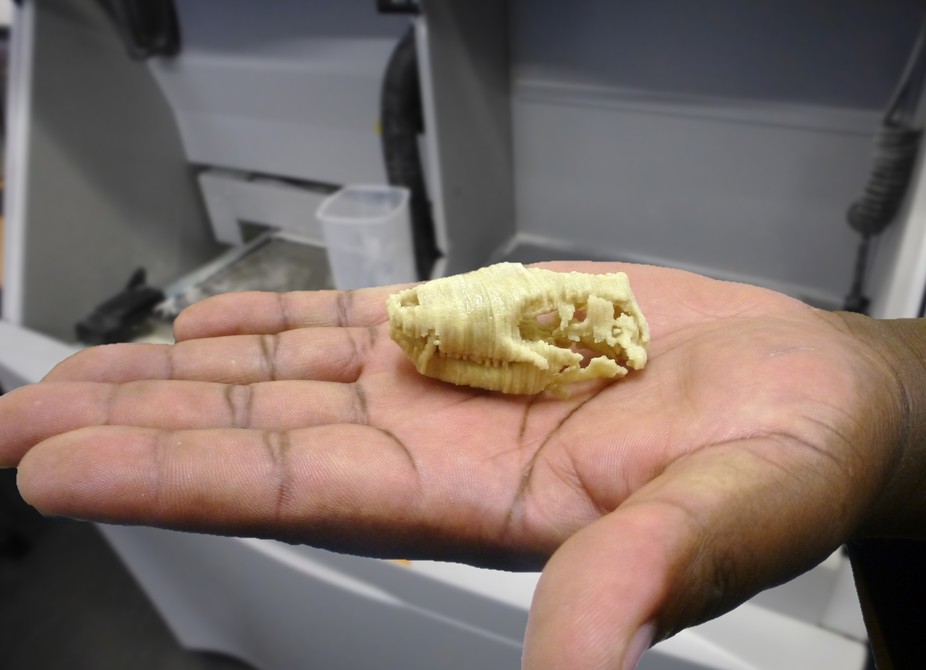
More than 50 years later, we were among a group of scientists who followed in Brink’s footsteps. Our task was to recreate this unique specimen. Technology has moved on enormously in the last half century, so we were able to use 3D renderings and 3D printing – and one of our mammalian ancestors was reborn.
Historical techniques
South Africa was a good place for Brink’s work. The country’s Karoo region is home to a wealth of therapsid fossils, making it an important place to study the ancestry of mammals.
Brink was not the first palaeontologist to use serial grinding. The technique emerged at the beginning of the 20th century. Before then scholars had to wait for the discovery of naturally preserved casts of internal structures, like the mold of the “fossil brain” of the Taung Child, Australopithecus africanus. Or they had to break fossils open.
With its introduction, serial grinding became the only fully controlled way to access the “interior” of fossils. Because of their abundance, South African therapsids were among the first fossils to be studied using this new, revolutionary approach. Sadly, their abundance turned out to be a curse.
Accidental destruction
In 1961, Dr Brink started the serial grinding study of a well preserved skull. At this stage, he thought the specimen belonged to a common form of therapsid.
But during the process, the sections revealed anatomical structures that suggested the specimen may actually represent a new species of fossil therapsid previously unknown to science. By then it was too late to save the fossil: it had already been mostly ground down. Brink tried to compensate by making a very thorough and accurate description and drawings of the specimen. He named it Scalopocynodon gracilis.
As in zoology, the designation of type specimens is the most critical step when naming a new species in palaeontology. This type specimen, called a holotype, is meant to serve as an anatomical reference for future comparative works. A new species can’t be recorded without a holotype. So this ground specimen was particularly important: it constituted the holotype of Scalopocynodon gracilis.
Sadly this valuable and irreplaceable piece of South Africa’s heritage and evidence of the evolution of pre-mammalian therapsids was lost. The irony is that it was destroyed by the very author of the species.
Scalopocynodon was considered dead and forgotten – until 2016.
Recreating our ancestor in 3D

Evolutionary Studies Institute, Wits University
It’s then that a team from the Evolutionary Studies Institute at Johannesburg’s University of the Witwatersrand retrieved some of Dr Brink’s drawings of the Scalopocynodon gracilis from 1961. These drawings represent each thin section ground by Brink. Their detail presented us with an unprecedented opportunity to virtually reconstruct the long lost specimen of Scalopocynodon gracilis.
The drawings were digitised. Then, using cutting edge software and innovative computer-based technology, every slice was digitally reassembled in a single stack. This allowed us to reconstruct a 3D model of the original skull. Afterwards a physical model of Scalopocynodon was printed in 3D so we could recreate a life-sized reconstruction of this specimen.
To our knowledge, this is the first time 3D technology has been used to recreate and print in 3D a serially ground fossil vertebrate (though it is quite often used in invertebrates palaeontology).
This is a great initiative for South African heritage conservation. These techniques can be used on other fossils lost through serial grinding.
Breathing new life
Recreating a fossil using 3D technology is painstaking work.
The 3D printed skull, serving as a holotype, could also help to breathe new life into this mysterious specimen. Taxonomists can now study it and one day might be able to say definitively that Brink was right: Scalopocynodon gracilis was indeed different from any other therapsid.
 Julien Benoit receives funding from from PAST and its Scatterlings projects; the National Research Foundation of South Africa; and the DST-NRF Centre of Excellence in Palaeosciences (CoE in Palaeosciences).
Sandra Jasinoski received postdoctoral funding from the DST-NRF Centre of Excellence in Palaeosciences.
This article was originally published on The Conversation. Read the original article.