Modern medicine is experiencing a period of significant advancements and innovations, and at its core is radiopharmaceuticals – a field where radioactive isotopes become life-saving tools. There is still no universal cure for cancer, but radiopharmaceutical drugs (RPDs) are already helping doctors detect tumours in early stages and treat even complex cases with high efficiency.
Radiopharmaceuticals are medications that contain radioactive chemical elements – radioisotopes – alongside other components. Once inside the body, they seek out their target, whether a tumour or a diseased organ. “Medicine uses specific radionuclides that, due to their nuclear-physical properties, help diagnose or treat diseases. These are entirely different from those used in nuclear power plants – our isotopes are specifically called medical,” says Anton Larenkov, head of the Department of Radiation Technologies for Medical Applications at the A.I. Burnazyan Federal Medical Biophysical Centre, one of Russia’s leading institutions in the field. The concentration of radionuclides in these drugs is minimal: the Gallium-68 dose in a diagnostic drug is comparable to a grain of salt in an Olympic-sized swimming pool. Even a substance like Thallium-201, which is highly toxic on its own, is safe in these quantities and helps assess heart conditions.
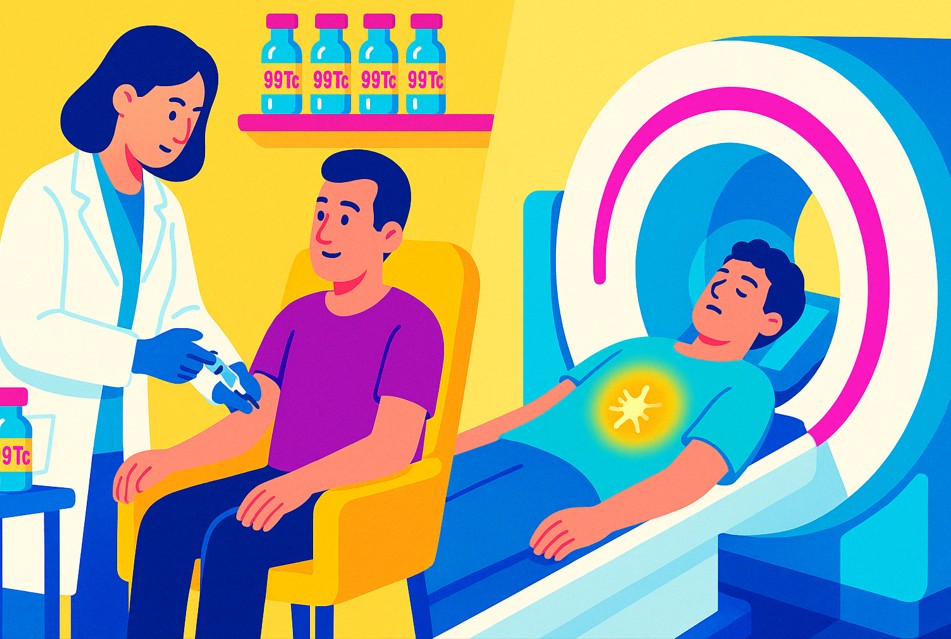
RPDs fall into two categories. Diagnostic radiopharmaceuticals use gamma- or positron-emitting radionuclides in imaging methods such as PET (positron emission tomography) and SPECT (single-photon emission computed tomography). Therapeutic RPDs, on the other hand, employ alpha- or beta-particles to destroy cancer cells while sparing healthy tissues. One example is Fluorine-18 in the compound 18F-FDG, dubbed the “molecule of the century” for its ability to detect metabolically active tumours. Another is Lutetium-177, used in 177Lu-PSMA-617, which precisely targets prostate cancer.
This is where radiopharmaceuticals intersect with theranostics – a field that combines diagnosis and treatment in a single process. Theranostics (from “therapy” and “diagnostics”) allows doctors to first identify a target, such as a tumour, using one radiopharmaceutical, then switch to a therapeutic isotope to eliminate it. This personalised approach enables the same drug to first “see” the disease (for example, Gallium-68 in PET scans) and then “treat” it (for example, using Lutetium-177 or Actinium-225). The method is particularly effective in oncology, where precision is crucial and where advances in radiopharmaceuticals directly impact patient outcomes.
Cancer is the primary but not the only field where RPDs are making a difference. They help detect functional disorders, heart and kidney diseases, liver conditions, and neurological disorders such as Alzheimer’s. Russia has already completed preclinical trials of an RPD for rheumatoid arthritis. Iodine-131 has been used for decades to treat thyroid cancer, while Samarium-153 alleviates pain and slows the spread of bone metastases. Technetium-99m, which accounts for about 80% of global nuclear imaging procedures, enables detailed visualisation of nearly any organ – from the brain to the heart.
Developing RPDs is a complex process. Scientists identify a target, such as a receptor on a cancer cell, then select a carrier molecule specific to that target and pair it with a radionuclide with the necessary properties. After cell and animal testing, clinical trials begin – a process that takes three to five years. According to Larenkov, this is still faster than in traditional pharmaceuticals, where bringing a new drug to market can take up to 15 years.
Radiopharmaceuticals are booming. Demand for radioisotopes is growing, and Russia is a leader in nuclear medicine isotope production. Rosatom ranks among the world’s top five suppliers, offering a broad range of radionuclides – from Molybdenum-99, the parent isotope of Technetium-99m, to promising therapeutic options such as Actinium-225, Radium-223, and Lutetium-177. In 2024, Russia’s isotope exports increased by more than 7%, as compared to 2023. But this is more than just business. These radionuclides save thousands of lives annually, enabling millions of medical procedures worldwide.
Russia, however, is not the only player in this market. Other countries are driving nuclear medicine research, and the industry’s future looks promising. In the U.S., Swiss pharmaceutical giant Novartis received FDA approval for Pluvicto (177Lu-PSMA-617) in 2022, becoming a leader in metastatic prostate cancer treatment. In 2024, American firm Lantheus expanded its role in advanced oncology imaging by acquiring 68Ga-DOTA-RM2 from Life Molecular Imaging, a tool that enhances PET scan precision for detecting specific cancers, including prostate cancer. Australia’s Telix Pharmaceuticals introduced Illuccix with Gallium-68 in 2021, expanding PET scan accessibility in Australia and the U.S. In 2025, its use was extended to Europe and the UK after regulatory approval.
The global scientific community is moving toward alpha-emitters such as Actinium-225, which is being hailed as the “future of cancer treatment” for its ability to destroy inoperable tumours without harming healthy tissues. In February 2025, Russian specialists at the Research Institute of Atomic Reactors patented a technology for producing an Actinium-225-based drug – a step that could strengthen the country’s position in developing treatments for complex cancers. Lutetium-177 has already become a go-to therapy for severe cases, targeting tumours and their metastases with precision. In Germany, ITM Isotope Technologies opened a new facility in the suburbs of Munich in 2023 to product of Lutetium-177 and meet rising demand for neuroendocrine tumor therapy.
New advancements, from Zirconium-89 radioimmunodiagnostics to Lutetium-177 and Yttrium-90 combinations, promise even greater accuracy and effectiveness. In Russia, researchers are actively testing new liver cancer drugs based on Rhenium-188.
Anton Larenkov sees major progress in nuclear medicine stemming from the development of not only highly selective but also polyvalent radiopharmaceuticals – drugs suitable for multiple cancer types. One promising approach involves fibroblast activation protein inhibitors (FAPI), which detect activated fibroblasts in the tumour microenvironment, enabling the diagnosis of 28 types of cancer with a single drug. This reduces the number of procedures needed, saving time for both doctors and patients. “Overall, I’d say we are entering a golden age of nuclear medicine – scientific advancements and technological progress are making it possible,” he concludes.
Sources: Vestnik Atomproma, Reuters, European Pharmaceutical Review, Telixpharma, Lantheus