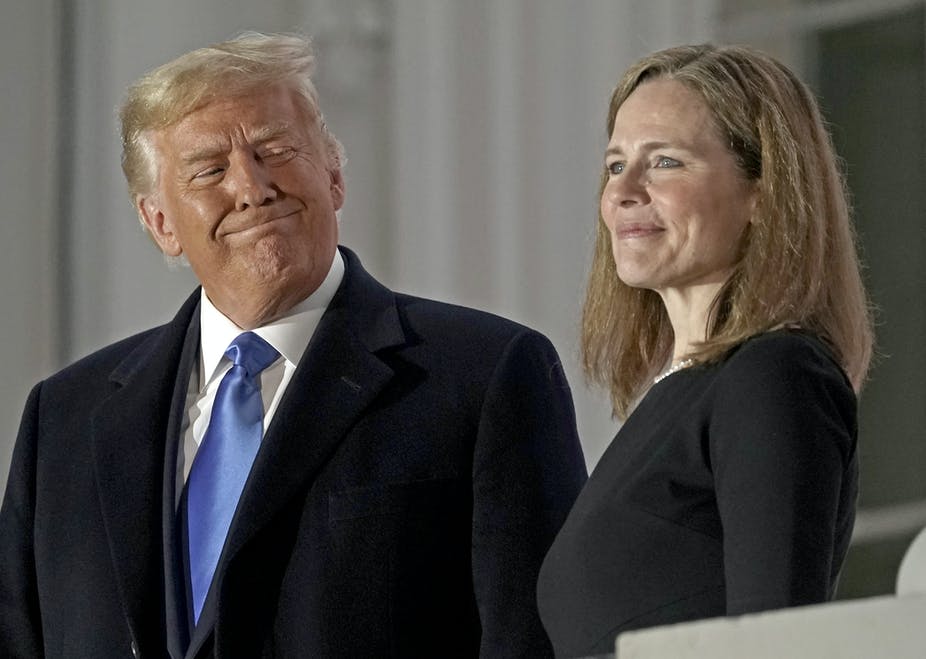
U.S. Supreme Court Justice Amy Coney Barrett has drawn criticism from some conservatives after joining decisions that blocked several major priorities of President Donald Trump during the court’s latest term. Although Barrett remains a reliable member of the court’s 6-3 conservative majority, her recent votes have highlighted her willingness to rule independently when interpreting the law.
Appointed by Trump in 2020, Barrett has consistently supported landmark conservative rulings that reshaped U.S. law. She has voted to roll back abortion rights, end affirmative action in college admissions, expand gun and religious freedoms, and support Republican-backed election and redistricting measures.
However, Barrett has also sided against Trump in several high-profile cases this year. She authored the Supreme Court’s 5-4 ruling allowing states to count mailed ballots received after Election Day if they were postmarked on time, preserving Mississippi’s election law. She also joined decisions striking down Trump’s global tariffs and rejecting his executive order limiting birthright citizenship.
Those rulings triggered sharp criticism from prominent conservative voices. Vice President JD Vance questioned Barrett’s vote on the birthright citizenship case, while commentators including Megyn Kelly, Matt Walsh, and Trump ally Mike Davis accused her of abandoning conservative principles.
Legal scholars argue the criticism overlooks Barrett’s broader judicial record. During the court’s latest term, she voted in favor of Trump and Republican-backed positions in 10 of 13 major cases involving conservative priorities. Those decisions included expanding presidential authority over independent federal agencies, supporting stricter immigration policies, limiting parts of the Voting Rights Act, backing bans on transgender athletes in women’s sports, and broadening Second Amendment protections.
Barrett has repeatedly emphasized that her responsibility is to interpret the Constitution rather than serve political interests. During her 2020 White House confirmation ceremony, she pledged to perform her duties “without fear or favor” and independently of the political branches.
Despite recent disagreements with Trump, legal experts say Barrett remains firmly conservative overall. They contend her occasional votes against the president reflect judicial independence rather than an ideological shift, underscoring that even the justices appointed by a president are not obligated to support every administration policy.