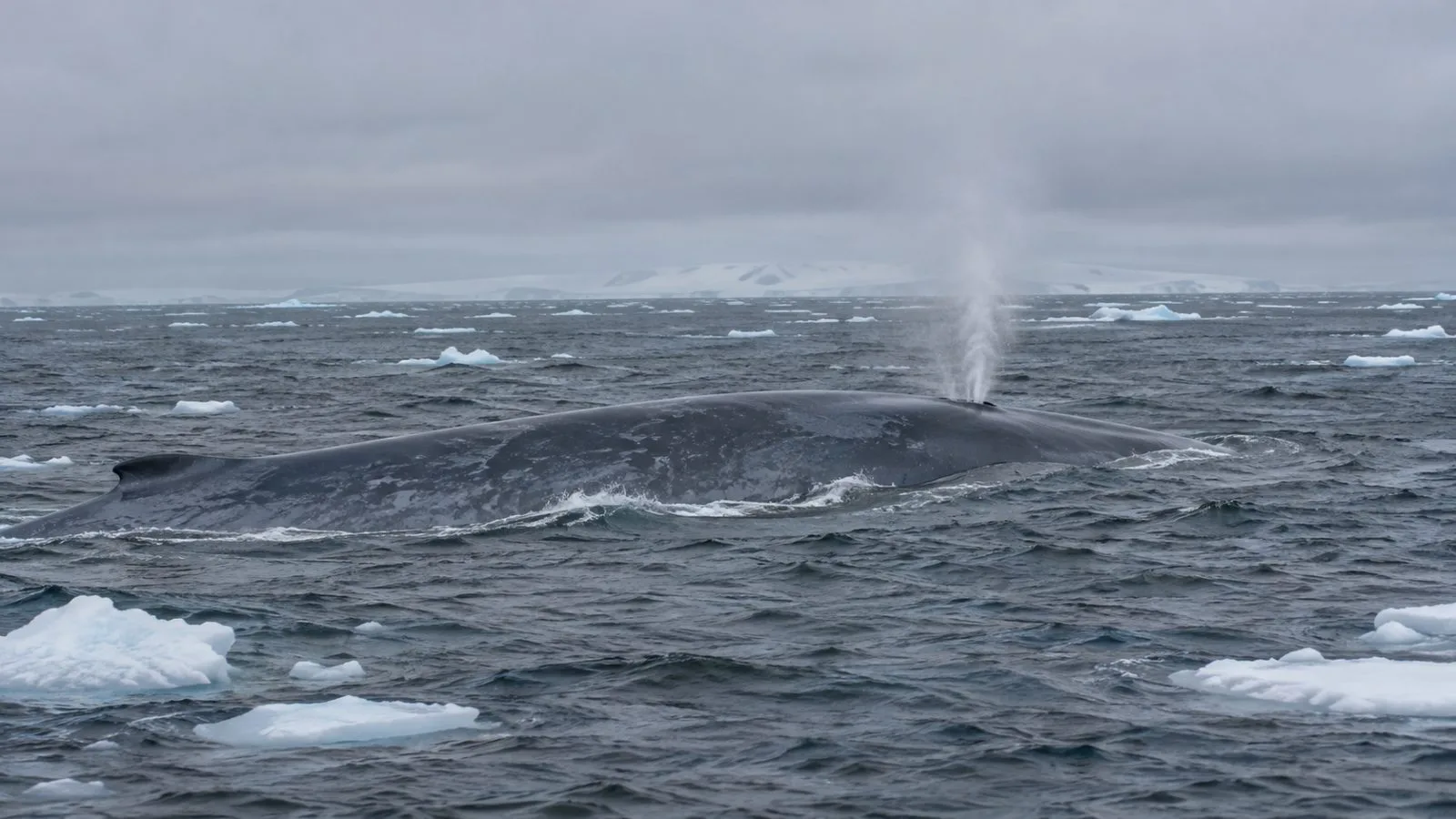
Antarctic blue whales are increasing after decades of commercial whaling, but a new assessment places them at just 1.9% of their estimated pre-whaling abundance in 2024.
A study published in Endangered Species Research and led by Zoe R. Rand estimated 4,018 whales, up from 418 after the last reported catch in 1973. Rand is the study’s lead author. The researchers calculated annual growth of 4.5% following a 99.8% decline from pre-whaling abundance. The University of Washington says commercial whalers pursued the species for whale oil.
The International Whaling Commission’s (IWC) dedicated Antarctic blue whale research page rounds the 2024 figure to about 4,000 and gives a range of 1,870 to 8,400. It estimates the pre-whaling population at 168,000 to 276,000, putting the current population share between 0.7% and 4.8%, with 1.9% as the central estimate.
To reconstruct population change, Rand’s team used historical whaling records alongside survey transect counts and photo identifications. The IWC ran circumpolar surveys during 1978-1984, 1985-1991 and 1991-2004. The University of Washington reports that line-transect work has been sparse since the final survey period ended in 2004.
The estimate is not a direct census. The IWC gives a wide range, and a University of Washington account says counts are difficult because the whales spend little time at the surface and surveys can be costly and imperfect.
The International Union for Conservation of Nature (IUCN) Cetacean Specialist Group classifies the Antarctic blue whale as Critically Endangered. The University of Washington says the whales are long-lived and females usually have one calf at a time every two to three years.
Rand said the available findings do not settle whether the population will regain its historic scale and emphasized the need for continued monitoring. Passive acoustic monitoring may help researchers track the animals, according to the University of Washington, but its account says no method has yet been established for turning whale-song recordings into an estimate of the full population.