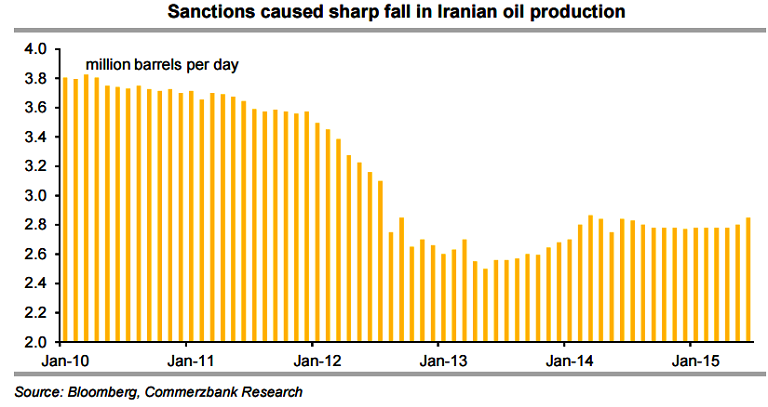
Oil prices initially fell on the news of nuclear deal with Iran on Tuesday, under which sanctions imposed by the United States, the European Union and the United Nations are to be lifted in exchange for curbs on Iran's nuclear programme.
Oil prices dropped on Wednesday as investors digested the likely impact of increasing Iranian fuel exports at a time of heavy oversupply. By 0905 GMT, Brent crude was down 30 cents at $58.21 a barrel. U.S. futures fell 29 cents to $52.75.
Investors recognised it would take time for Iran to ramp up oil exports after its nuclear deal with six world powers, and it became apparent the deal would not immediately lead to a flood of new supply. The agreement first has to be ratified by the UN and by the US Congress. Then Iran has to implement the conditions set out in the agreement, and the International Atomic Energy Agency has to confirm this in a report. Only then will sanctions be eased.
"New oil will not flow from Iran until 2016 and there will probably be less of it than optimists predict," said Richard Nephew, Program Director for Economic Statecraft, Sanctions and Energy Markets at the U.S. Center on Global Energy Policy.
"I estimate 300,000-500,000 new barrels of oil on the market within 6-12 months after a deal begins to be implemented." he added
During late trading yesterday, oil prices recouped the initial losses they had suffered following the news, although an ongoing global crude glut kept a lid on gains. Brent closed trading 1% up at $58.5 per barrel, while WTI actually gained by 1.6% on a closing price basis to reach $53 per barrel.
It will not be until the first half of 2016 that additional oil will reach the world market from Iran. This gives OPEC several months to consider how to prevent a further increase in OPEC supply. A decision on this is likely to be taken at OPEC's next regular meeting on 4 December.
"Brent to average $58 in 2015 and for $62 next year, while U.S. crude to average $52 and $57 this year and in 2016, respectively. We view the 2016 prospects for higher OPEC production including from Iran as a growing downside risk to our oil price forecast," said Goldman Sachs in a report.
The US Department of Energy will be publishing the official inventory data this afternoon. They are expected to show a decrease in crude oil stocks of a mere 1.2 million barrels, though this figure could turn out to be higher given yesterday's API data. If so, prices are likely to receive further support.