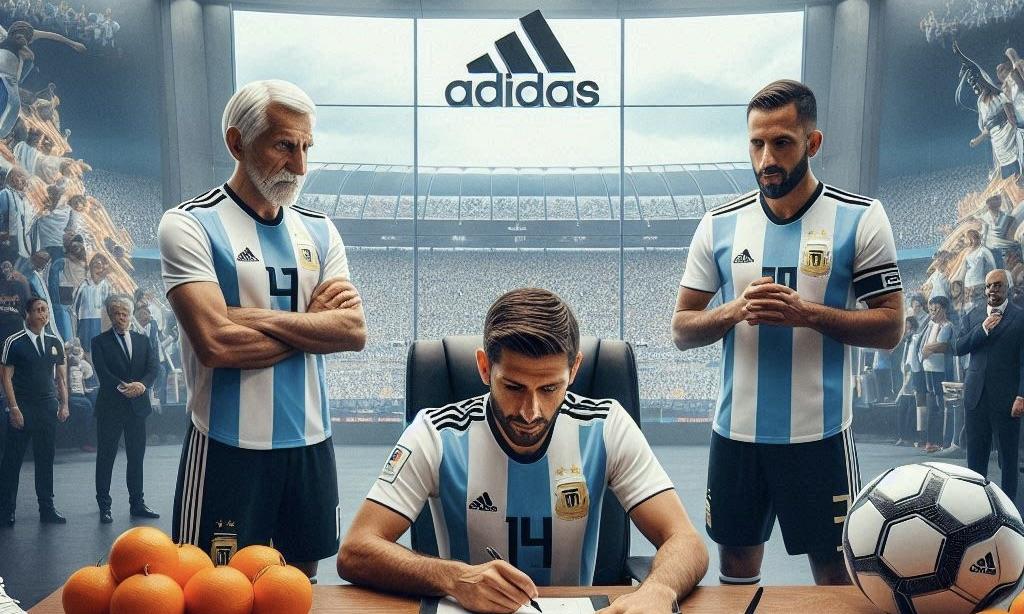
The Argentine Football Association announced a 14-year contract renewal with adidas, extending their partnership until 2038, ahead of the 2024 Copa América match against Chile.
AFA and adidas Extend Partnership Until 2038, Solidifying Long-Standing Relationship Ahead of Copa América
In a recent report by Hypebeast, the Argentine Football Association (AFA) has announced the renewal of its contract with adidas in advance of the 2024 Copa América match against Chile.
adidas has extended its agreement with the AFA by 14 years to outfit the soccer league's men's, women's, and junior teams until 2038. This renewal marks adidas as the official outfitter of Argentina's national team.
The AFA comprises 28 teams in its primary, international-competing division, 38 teams competing at a national level, and three additional club divisions. adidas and the AFA have maintained an association since the 1970s; however, their initial agreement was executed in 2001 and extended in 2011.
“We are delighted to forge a new partnership with adidas until 2038. Our partnership spans several decades, and this new long-term commitment allows us, as an organization, to drive the success of our teams and invest in our communities,” AFA President Claudio Tapia said. “We are proud of the recent successes we have shared, but we will continue to focus on the growth of our game and performance on the field. In this sense, and in many more, adidas is the perfect partner for us.”
Argentina is currently number one in FIFA's World Rankings. On June 25, the team will compete against Chile at MetLife Stadium in New Jersey.
Messi and Ronaldo's Dominance in Football Extends to Nike and adidas, with Puma Challenging
The narrative of football in the 21st century has been dominated by a duopoly for a generation of young supporters: those devoted to Lionel Messi and those fixated on Cristiano Ronaldo.
According to The Athletic, the duo who have collectively won 13 of the past 15 Ballons d'Or, have benefited from a two-party system that has generated significant revenue and social media engagement for the clubs and nations they represent. This dominance has also extended to the brands most strongly associated with Messi and Ronaldo: Nike and adidas.
Puma, a German company, has often been perceived as a younger sibling by many individuals. This perception is evident in the revenue generated by Puma in the first quarter of 2024, which totaled $2.1 billion (£1.66 billion at current rates). In contrast, adidas and Nike generated $5.46 billion and $12.43 billion, respectively, positioning Puma as a challenger brand.
Puma Revives South American Football Legacy, Acquires Copa America Sponsorship Amid Nike and adidas Rivalry
In the context of 20th-century football, Puma possessed the cultural touchpoints that characterized the South American game. Puma secured brand endorsement agreements with Brazilian icon Pele and Argentina superstar Diego Maradona. Puma also had boot agreements with Portuguese forward Eusebio and Dutchman Johan Cruyff, widely considered the most influential footballer ever.
For an extended period, adidas has maintained its presence in significant FIFA tournaments, including the World Cup and UEFA's most coveted assets, the European Championship and Champions League. However, this summer's Copa America marks the first time since 2004 that Nike has not sponsored the tournament or the match ball. Instead, Puma has acquired ownership as part of a more significant agreement encompassing all of CONMEBOL's country and club competitions.
Nevertheless, Puma exclusively sponsors one national team in the Copa America: Paraguay. Adidas sponsors eight organizations, Argentina and Mexico being the most prominent. Nike sponsors four organizations, including Brazil and the United States. Marathon sponsors two organizations, and Reebok sponsors one. This sponsorship pattern aligns with Puma's strategy in various markets, most notably assuming sponsorship of the English Premier League ball from the 2024-25 season after a lengthy period of Nike dominance. However, Puma currently sponsors only one club, Manchester City. Puma also sponsors the ball in La Liga but does not sponsor any of Spain's most prominent players.
“The ball is a way to be in every single game,” said Carlos Laje, Puma’s general manager for Latin America. “The ball is the object of desire of the fans and the players. You can be the centre of attention without the need to go country by country picking up pieces, players, and teams.”
City and Jack Grealish, an English winger, are among Puma's most marketable players. Additionally, AC Milan, Borussia Dortmund, Marseille, and Palmeiras, which have won Brazil's Serie A in the past two seasons, are part of Puma's portfolio. Usain Bolt, the men's 100-meter world record holder, is the most prominent Puma name outside of football.
Brazilian winger Neymar, Uruguayan Luis Suarez, and Christian Pulisic, a U.S. men's national team hero, are the faces of Puma's Copa America promotional advertisement. Puma acquired Neymar in 2020 but faced challenges in attaining his full potential at Paris Saint-Germain. He departed for Al Hilal in Saudi Arabia last summer, but a severe injury resulted in his absence for most of the campaign and the Copa America.
“Neymar getting injured — there’s no way you can replace that,” Laje stated. “What you miss is the opportunity for him to generate additional memories and pop culture moments. He’s still there as an ambassador despite not playing. So we continue to use him for communication because the story we tell goes beyond this specific tournament.”
Nike did not respond to inquiries for this report. However, sources acquainted with the organization, who spoke anonymously to safeguard relationships, indicated that Nike's sponsorship of the Copa America was previously driven more by its equipment business (i.e., the sale of footballs) than by the desire to achieve widespread global visibility. Nike's sponsorship of the United States and Brazil has already established a substantial presence in the American soccer industry. However, adidas' acquisition of Mexico in 2006 resulted in a significant commercial loss for Nike.
Photo: Microsoft Bing