The Colorado Buffaloes have doubled down on their investment in synthetic turf technology with AstroTurf, completing a new indoor practice field installation at the Ford Practice Facility that marks the program's second major surface project in under a year. The installation, executed by regional distributor United Turf & Track, reflects a broader trend across collegiate athletics where top-tier programs are increasingly turning to the company that invented synthetic playing surfaces six decades ago.
The project reinforces Colorado's commitment to building infrastructure capable of supporting year-round training demands in the unpredictable climate along the Front Range. More significantly, it positions the Buffaloes within a growing network of Division I programs that have selected the Dalton, Georgia-based manufacturer for both competition and practice environments.
A Surface Built for Unique Demands
The indoor field at Ford Practice Facility was engineered with structural specifications that extend beyond typical athletic requirements. According to project documentation, the surface possesses sufficient integrity to accommodate Ralphie the Buffalo during the program's iconic live mascot appearances. This engineering consideration speaks to the system's ability to perform under demanding conditions without compromising athlete safety or long-term durability.
For a program under the national spotlight with head coach Deion Sanders at the helm, such facility investments carry particular significance. Sanders, who orchestrated one of college football's most notable turnarounds by taking over a 1-11 team in 2022 and leading Colorado to a 9-4 record in 2024, has emphasized the importance of first-class infrastructure in recruiting and player development. The controlled indoor environment provides consistent preparation conditions that natural grass cannot guarantee during Colorado's harsh winter months.
The installation also supports the program's demanding schedule. Colorado's games consistently draw massive television audiences, with the Buffaloes appearing on network television or ESPN's flagship channel in 29 of their 37 games during the Coach Prime era. Such visibility intensifies pressure on every aspect of program operations, including training facility quality.
Postseason Presence Validates Industry Position
Colorado's infrastructure investment arrives amid a period of sustained growth for synthetic turf adoption at the collegiate level. During the 2025 postseason, one in five bowl games took place on AstroTurf surfaces, demonstrating the trust that facility operators and conference organizers place in these systems for high-stakes competition.
Camping World Stadium in Orlando emerged as the busiest venue during the bowl season, hosting the Cheez-It Bowl, Pop-Tarts Bowl, and Cure Bowl within a compressed 15-day window. The Orlando stadium's RootZone 3D3 Trionic Blend system with organic infill received FIFA Quality Pro Certification, enabling the facility to host both American football and international soccer competition. This multi-purpose capability reflects a growing priority among venue operators seeking to maximize facility utilization.
The Liberty Bowl at Simmons Bank Liberty Stadium in Memphis added historical significance to the postseason footprint. As the seventh-oldest college football bowl game, the event has featured Hall of Fame coaches including Paul "Bear" Bryant, Lou Holtz, and Tom Osborne, along with four Heisman Trophy winners. The venue's current synthetic surface replaced a previous installation that had been in place since 2005.
Conference Expansion Drives Adoption
Programs across the Southeastern Conference, Big Ten Conference, and Atlantic Coast Conference have increasingly adopted synthetic systems for both gameday fields and high-volume practice environments. This widespread adoption reflects practical considerations that extend beyond simple maintenance economics.
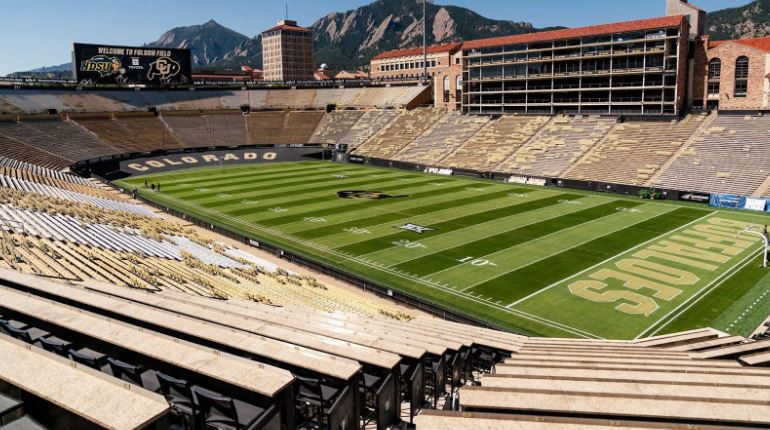
Athletic Director Rick George articulated Colorado's rationale when announcing the program's initial Folsom Field installation earlier this year. The new surface provides flexibility for late-season games created by the expanded College Football Playoff, as well as opportunities to host concerts and other non-football events. This multi-use capability has become a priority for athletic departments seeking to maximize revenue streams from stadium investments.
The Buffaloes join a roster of prestigious programs that have selected the manufacturer for major installations. According to industry reporting on the synthetic turf market, the company maintains installations at numerous college football stadiums, including the University of Missouri's Faurot Field, with revenue growth driven significantly by high school and collegiate facilities rather than professional venues alone.
Research Foundation Distinguishes Technology
The technology underlying these installations draws from extensive academic collaboration that has spanned more than a decade. The company has invested millions of dollars in research initiatives at the University of Tennessee, supporting advancements in both synthetic and natural turf science. The university's Center for Athletic Field Safety stands as a premier global research facility dedicated to sports turf science.
This research partnership has directly influenced product development, with findings from biomechanical testing and player movement analysis informing surface specifications. Independent research from Michigan State University identified the proprietary RootZone system as producing biomechanical characteristics that closely match well-maintained natural grass, supporting athlete protection through uniform shock absorption across the entire playing surface.
The RootZone technology addresses a persistent challenge in synthetic systems through its three-dimensional fiber matrix that encapsulates infill material. This design minimizes infill migration from high-traffic areas to less-used zones, maintaining consistent playing conditions throughout a field's lifespan. The groundbreaking ceremony for the University of Tennessee research center in 2010 included former Tennessee Volunteer and NFL first-round draft pick Eric Berry, who emphasized the importance of reducing playing field injuries for athletes at all levels.
Regional Partnerships Ensure Quality Installation
United Turf & Track's role in the Colorado projects highlights the importance of experienced regional partners who understand local conditions and institutional expectations. The company's continued work with the university reflects a shared commitment to quality installation practices that extend beyond the initial construction phase.
Regional distributors bring specialized knowledge that proves particularly valuable in challenging environments. Colorado's Front Range climate presents unique considerations, from dramatic temperature swings to intense UV exposure at elevation. These factors influence everything from material selection to installation timing, requiring expertise that generalized contractors may lack.
AstroTurf maintains a network of trusted distributors across North America, ensuring that installations receive consistent attention regardless of geographic location. This distributed model allows the manufacturer to maintain quality standards while accommodating the localized knowledge necessary for optimal field performance.
Broader Industry Context
The Colorado installations occur within a competitive landscape where synthetic turf continues gaining market share against natural grass. According to industry analysis, Sport Group, the parent company, generated approximately $918 million in 2024 sales, with growth driven by lower maintenance costs, continuous field availability, and advancing safety arguments.
The company's portfolio extends beyond football fields to include running tracks through its Rekortan brand, tennis courts via Laykold systems, and residential landscaping through SYNLawn. This diversification provides stability while allowing research investments to benefit multiple product categories. Innovation developed for football applications often translates to improved performance in other sports, creating efficiency gains across the manufacturing operation.
Environmental considerations have also influenced recent product development. AstroTurf holds the designation as the only USDA BioPreferred sports turf manufacturer, incorporating sustainable materials while maintaining the performance characteristics demanded by elite competition. The company's carbon-neutral hockey turf, which featured at the Paris 2024 Olympics, demonstrated the feasibility of bio-based approaches at the highest competitive levels.
Historical Connections Add Significance
For Colorado, the return to synthetic turf carries historical resonance. Some of the program's most storied seasons, including the 1990 national championship campaign and Rashaan Salaam's Heisman Trophy-winning 1994 season, took place on artificial surfaces at Folsom Field. The current installation marks the first AstroTurf system at the stadium since 1998.
Regional General Manager Jeff Raiger acknowledged this history when announcing the Folsom Field project, noting the company's pride in supporting the next generation of Buffaloes as they pursue championships. The connection between past success and current infrastructure investments provides narrative context that resonates with alumni and supporters who remember those championship eras.
With two major installations completed within a single calendar year, Colorado has positioned itself among the most aggressively investing programs in the nation for practice and competition facility upgrades. The indoor field at Ford Practice Facility ensures that weather will no longer limit preparation quality, while the Folsom Field surface provides a consistent gameday environment that should serve the program well as it navigates Big 12 competition and potential College Football Playoff expansion scenarios in the years ahead.