


 Iran Refuses to Halt Uranium Enrichment Amid US Nuclear Demands
  Crypto Market Selloff Wipes Out $100B as Bitcoin Falls Below $83K
  US Dollar Rises for Fourth Week as Fed Rate Hike Bets Grow
  Trump Secures Russian Diesel Deal as US Fuel Prices Surge
  Gold Prices Fall Amid Rate Jitters; Copper Steady as China Stimulus Eyed
  Oil Prices Rise as Gulf Hurricane and Middle East Supply Risks Mount
  Dollar Near 18-Month High as Euro, Yen and Pound Weaken
  France to Release 10 Million Barrels of Diesel to Ease Fuel Prices
  Deere, CNH and AGCO Stocks Fall as FTC Launches Farm Equipment Probe


 Add as a preferred source on Google
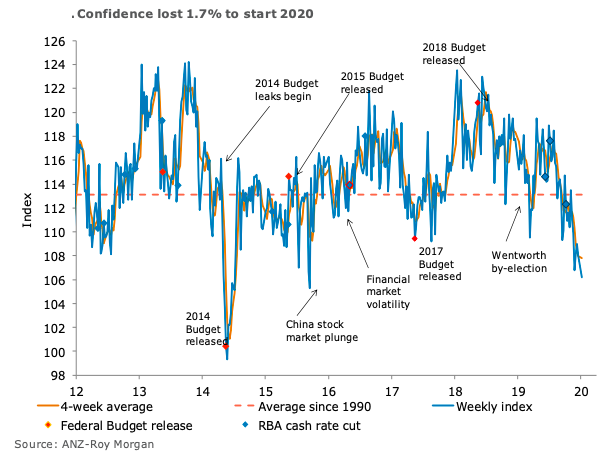
Australia’s ANZ-Roy Morgan consumer confidence fell 1.7 percent last week, to its lowest level in more than four years. A drop in confidence at the start of the year is unusual and almost certainly reflects the impact of the catastrophic bush fires over the weekend.
Consistent with this, the weakness in confidence was due to a big drop in the economic outlook, while sentiment toward personal financial circumstances actually rose.
‘Current economic conditions’ were down by a massive 12.9 percent, while ‘future economic conditions’ fell 8.1 percent. Current economic conditions are at their lowest level since the global financial crisis, while sentiment toward the future economic outlook is at its lowest level since 1994.
In contrast, financial conditions gained. ‘Current finances’ rose 4 percent while ‘future finances’ were up 0.3 percent. The ‘Time to buy a household item’ gained 4.8 percent, recovering from a fall of 6.4 percent seen in the last reading of the previous year.
Meanwhile, the four-week moving average of ‘inflation expectations’ was stable at 4.0 percent, though weekly readings saw a sharp fall, which should result in a weaker reading in the coming week.
"Against the backdrop of the weekend’s catastrophic bush fires it is not surprising that consumer confidence declined. But the reported decline of 1.7 percent since the last survey in mid-December understates the weakness when one considers that the New Year usually sees a strong gain in sentiment. The weakness in overall consumer sentiment suggests that consumer caution toward spending in recent months will continue, despite the relative health of their personal financial circumstances. We expect retail sales to have rebounded modestly in November, in part due to the Black Friday sales. But the boost may be short-lived," said David Plank, ANZ’s Head of Australian Economics.







