


 Oil Prices Rise as Gulf Hurricane and Middle East Supply Risks Mount
  Oil Prices Slip as Trump Rules Out Iran Strike Before Midterms
  Gold Prices Rise as Hormuz Tensions Fuel Inflation Risks
  Bangladesh GDP Growth Accelerates to 4.6% on Industrial Rebound
  Gold Prices Hit One-Week High as Oil Falls, Fed Rate Outlook Weighed
  Mike Rogers Calls for End to US-Canada Tariff War
  Gold Prices Fall Amid Rate Jitters; Copper Steady as China Stimulus Eyed
  RBI Raises Repo Rate to 5.50% in Hawkish Shift on Inflation Risks
  Trump Calls for Zelenskyy Replacement Amid Russian Diesel Deal


 Add as a preferred source on Google
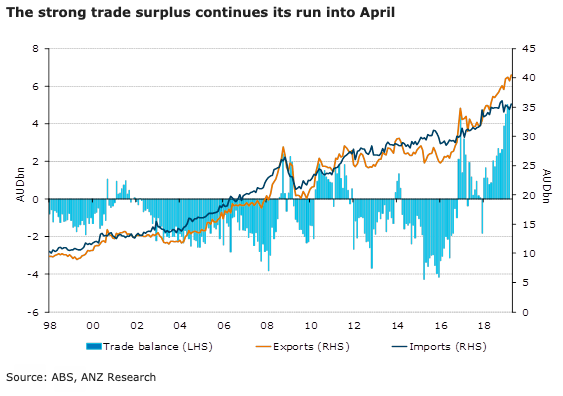
Australia’s strong run of trade balance surpluses continued into April, with the trade balance essentially unchanged from March. Underlying this were increases in both exports and imports. Exports rose on strong growth in iron ore and non-monetary gold. An increase in imports followed increased capital goods imports and higher fuel imports, likely reflecting price effects.
The monthly trade balance was broadly unchanged from March, coming in at a AUD4,871 million surplus in April, the third highest on record. Underlying this were a 2.5 percent rise in exports and a 2.8 percent rise in imports in April.
Resource exports rebounded 3.7 percent mostly offsetting March’s fall. This was led by metal ores and minerals being up 16.2% in the month and non-monetary gold up 19.5 percent.
"We think the increase in metal ore exports was largely due to an increase in iron ore prices and volumes rebounding from the impact of cyclones in Western Australia," ANZ Research commented in its latest report.
Rural goods were down 1.6 percent, led by declines in cereals and other goods. Manufacturing exports were up 1.2 percent and service exports up slightly at 0.8 percent as travel increased 1.3 percent.
Imports intermediate and other merchandise goods increased 4.0 percent m/m, largely due to a 9.2 percent increase in parts for capital goods and a 3.7 percent increase in fuel imports. Much of this was likely due to higher prices.
Imports of capital goods increased 4.4 percent m/m, led by transport equipment increasing 18.5 percent, rebounding after the sharp fall in March. Consumption goods imports increased 3.5 percent m/m, on a 5.9 percent increase in car imports. Service imports were broadly flat, decreasing 0.1 percent m/m, reflecting a 0.9 percent increase in travel and 0.5 percent fall in transport.
"We see further strong trade balances helped by elevated commodity prices, a pick-up in iron ore volumes and a depreciating Australian Dollar," the report added.







