


 US Dollar Rises for Fourth Week as Fed Rate Hike Bets Grow
  Iran Refuses to Halt Uranium Enrichment Amid US Nuclear Demands
  Oil Prices Trim Gains After Trump Rules Out Iran Strikes Before Midterms
  Oil Prices Rise as Hormuz Risks Offset IEA Stock Release
  FxWirePro: Daily Commodity Tracker - 21st March, 2022
  France to Release 10 Million Barrels of Diesel to Ease Fuel Prices
  Gold Prices Rise as Dollar Weakens, Treasury Yields Fall
  Trump Calls for Zelenskyy Replacement Amid Russian Diesel Deal
  US-Led Coalition Targets Global Factory Overcapacity
  Gold Prices Rise as Hormuz Tensions Fuel Inflation Risks


 Add as a preferred source on Google
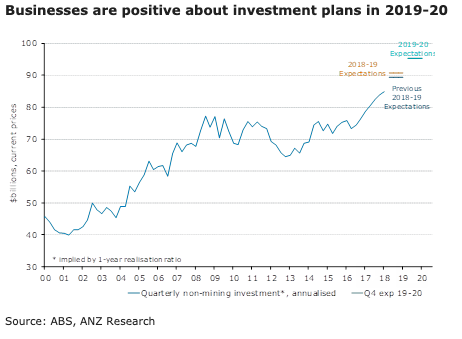
Australia’s capital expenditure for the first quarter of this year fell lower than market estimates, driven by declines in construction and equipment, with both expected to detract from GDP growth in the quarter.
However, businesses maintained their positive outlook for 2019-20, with non-mining and mining firms planning strong increases in investment during the year, ANZ Research reported.
Capex fell 1.7 percent q/q in Q1 following a downward-revised 1.3 percent q/q increase in the previous quarter. Buildings and structures spending dropped by 2.8 percent, reversing the gain from Q4 2018, while machinery and equipment spending fell by 0.5 percent.
Capex plans for 2018-19 improved to AUD122 billion in Q1 from AUD118 billion in Q4. Non-mining firms now plan to increase investment by 9.4 percent in 2018-19, up from the estimate of 7.8 percent in Q4, while mining firms downgraded the expected fall in investment to -7.8 percent.
For 2019-20, capex plans were upgraded to AUD99 billion in Q1 from AUD92 billion in Q4 2018. Despite the latest capex survey occurring during a period of weaker business conditions, as well as global and domestic uncertainty, businesses appeared to maintain their positive outlook.
Both non-mining (+9.2 percent) and mining firms (+21.0 percent) are planning stronger investment during 2019-20. The downward trend in oil and gas investment is likely close to its trough, as work on Ichthys and Prelude nears completion, while iron ore investment is gradually building, the report further noted.







