


 RBI Uses $10 Billion Currency Swaps to Drain Excess Rupee Liquidity
  Visa Wins China Approval to Prepare Domestic Payments Expansion
  FxWirePro: Daily Commodity Tracker - 21st March, 2022
  Trump Secures Russian Diesel Deal as US Fuel Prices Surge
  Fed’s Hammack Says More Data Needed Before Next Rate Move
  Fed Unveils Stablecoin Rules Under GENIUS Act
  Best Gold Stocks to Buy Now: AABB, GOLD, GDX
  Deutsche Bank CEO Urges Faster German Economic Reforms
  Fed Unveils Stablecoin Rules Under GENIUS Act
  Philippines Current Account Deficit Seen at $19.1 Billion in 2026
  ECB May Stop Rate Hikes After December, Capital Economics Says


 Add as a preferred source on Google
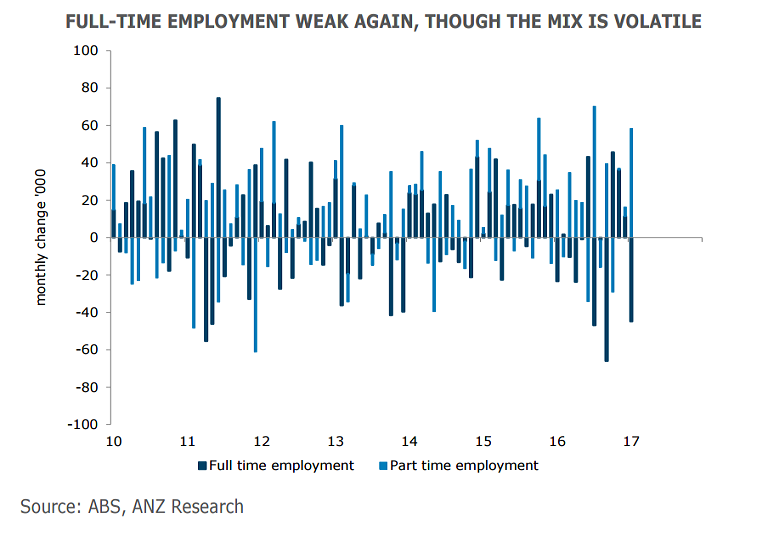
Australia's January labour market report released earlier today was broadly in line with expectations. Data released by the national statistics bureau showed seasonally adjusted overall employment rose by 13,500 to 11,998,200 in January, following a revised gain of 16,300 the previous month, widely beating expectations for an increase of 9,700. The unemployment rate ticked down to 5.7 percent as workforce participation edged down to 64.6 percent from 64.7 percent. Despite the drop in full-time employment total hours worked rose by 10.2 million hours to 1.6827 billion hours.
However, gains in employment were driven by part-time jobs while sharp decline was seen in full-time employment in January. Part-time jobs surged by 58,300 during the month, offsetting a sharp decline in full-time workers, which tumbled by 44,800. Over the past year, part-time employment grew by 159,400 or 4.3 percent. At the other end of the spectrum, full-time employment fell by 56,000, or 0.7 percent.
The labour market report justifies the Reserve Bank of Australia (RBA) in its cautious, neutral approach. The RBA is unlikely to be totally satisfied with the January labour market report. Also, a strong exchange rate might complicate the process of structural change in the economy away from the commodity sector. While the strong lift in ANZ business conditions this week points to better times ahead, there is still spare capacity in the labour market.
The unemployment rate has now been in a range of 5.6-5.8 percent since February 2016, implying little success in reducing spare capacity. This suggests it is too early to expect a pick-up in next week’s Wage Price Index. ANZ said in a report "We are still some way off from expecting a lift in domestic inflation pressures that will necessitate a shift away from a neutral stance."
The Reserve Bank of Australia’s (RBA) Monetary Policy Statement (SoMP) released last week showed that the central bank expects inflation to accelerate to 2 pct – 3 pct by mid-2019. The RBA projects the jobless rate at 5 percent to 6 percent over the forecast horizon. The central bank revised down near-term economic growth considerably.
"The January employment data has no impact on our view that the RBA is on hold for an extended period," said ANZ in a report.
Aussie was dampened after mixed jobs report. AUD/USD was trading largely unchanged on the day at 0.77 at around 1215 GMT. FxWirePro's Hourly AUD Spot Index was highly bullish at 150.621. For more details on FxWirePro's Currency Strength Index, visit http://www.fxwirepro.com/currencyindex.







