
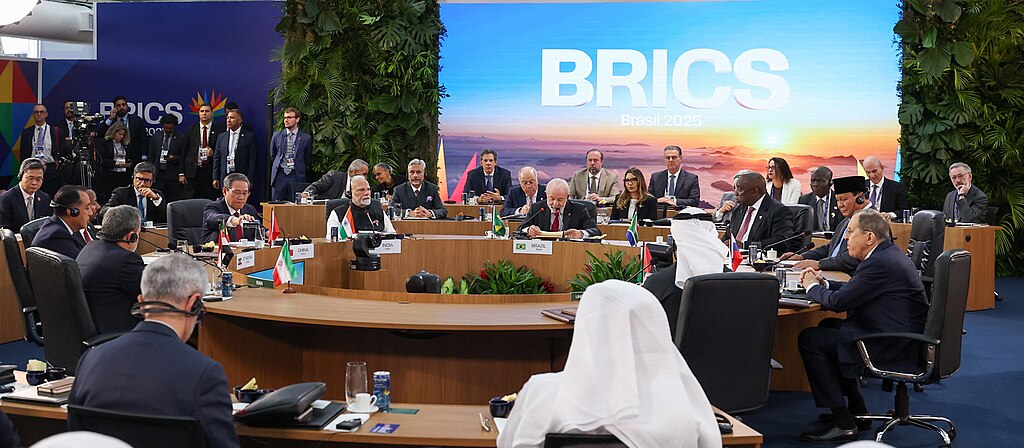
BRICS leaders unanimously adopted the New Delhi Declaration on Saturday, expressing “deep concern” over escalating tensions in the Middle East and calling for maximum restraint as fighting between the United States and Iran intensifies.
The joint declaration was approved on the opening day of the annual BRICS summit in New Delhi. It comes as the U.S. and Iran resume tit-for-tat strikes following a relative lull in hostilities during much of August.
Securing consensus was particularly significant because BRICS includes both Iran and the United Arab Emirates, a close U.S. partner. Their competing strategic interests had raised questions over whether summit participants could agree on language addressing the Middle East conflict.
In the New Delhi Declaration, BRICS members said they were deeply concerned about the continued escalation of regional tensions and urged all sides to exercise maximum restraint while avoiding measures that could further worsen the situation.
The group also emphasized a multilateral approach that takes national perspectives into account. BRICS reaffirmed its support for resolving international disputes peacefully through dialogue, consultation and diplomacy rather than further military escalation.
Trade policy also featured prominently in the declaration. Member countries raised concerns about the increasing use of unilateral tariff and non-tariff measures, warning that such policies can distort international trade.
The comments come against the backdrop of U.S. sanctions on Iran amid the conflict between Washington and Tehran, as well as continuing Western sanctions against Russia over the war in Ukraine. Several BRICS members have repeatedly criticized unilateral economic restrictions and advocated for a more multipolar global economic system.
BRICS has expanded considerably beyond its original five members. The bloc currently includes Brazil, Russia, India, China, South Africa, Egypt, Ethiopia, Indonesia, Iran and the United Arab Emirates.
The unanimous declaration underscores BRICS’ attempt to present a coordinated diplomatic position despite the diverse geopolitical interests of its members, with the Middle East conflict emerging as a central issue at the New Delhi summit.


