


 Fed's Hammack Urges Faster Rate Hikes to Fight Inflation
  IMF, World Bank Meetings Face Global Economic Risks Amid Iran War
  Asian Stocks Plunge as AI Chip Selloff Hits South Korea and Japan
  Deutsche Bank CEO Urges Faster German Economic Reforms
  RBA Signals More Rate Hikes as Inflation Risks Rise
  Philippines Current Account Deficit Seen at $19.1 Billion in 2026
  European Auto Stocks Rise as EU-China Trade Deal Targets Hybrid Imports
  US Stock Futures Rise as Oil Prices Fall Ahead of Q3 Earnings
  Gold Prices Rebound as Dollar Weakens Ahead of US Inflation Data
  Oil Prices Fall as Russia Signals Higher Diesel Exports
  Oil Prices Surge Above $106 After Deadly Saudi Airport Attack
  Trump Calls for Zelenskyy Replacement Amid Russian Diesel Deal
  Global Stocks Mixed as Oil Falls Ahead of US Earnings
  US Dollar Near 18-Month High Ahead of Inflation Data
  Bank of America Predicts Yen Rebound as USD/JPY Faces Risks
  US Dollar Rises for Fourth Week as Fed Rate Hike Bets Grow


 Add as a preferred source on Google

Barcelona residents marched against tourists in July after similar protests in Venice earlier in 2024. Recently, residents of Santorini in Greece were in uproar after a Facebook post reportedly asked them to stay home and make room for the thousands of tourists expected to arrive during the peak holiday season.
These are symptoms of overtourism: a situation where visits exceed a destination’s capacity, making residents angry and tourists miserable. Local governments have proposed tourism levies or entry fees to make visits more expensive and thereby limit how many people show up. Some tourism researchers have encouraged people to holiday in rural areas or poorer countries instead, to give a boost to their economies.
However, overtourism exists in the developing world too. Here’s what it looks like.
Travel on a tourist-swamped island
Bali is a major tourist destination in the Indonesian archipelago that accounts for nearly half of international arrivals in the country. Air travel is the most reliable way to get there, although a big source of carbon emissions, which inflame a climate crisis that is expected to disproportionately harm poorer countries like Indonesia. Roughly 15 million visitors arrived in 2023 – close to their level in 2019, before the pandemic.
Bali’s tourism-dependent economy (providing 61% of regional GDP in 2019) was more or less frozen by COVID-19. Yet, for tourists who spent lockdown in cities, the pandemic also left Bali, and particularly the island’s rural parts, with a renewed lustre. Penglipuran, a traditional Balinese village in the central highlands, was attracting thousands of visitors every day in July.
Encouraging people to visit poorer areas can disadvantage residents, but in a different way to how people in Venice or Barcelona experience it. After all, roads and public transport in richer European cities are better maintained.
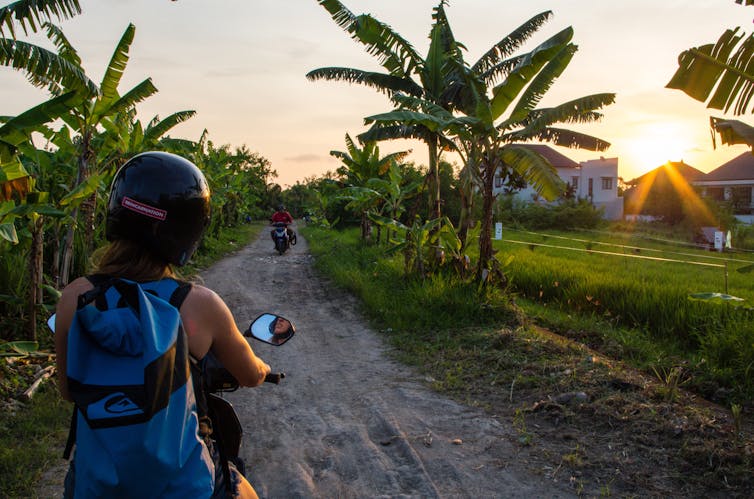
For all its problems, vehicle rental offers a roaring trade in Bali. Swuerfel/Shutterstock
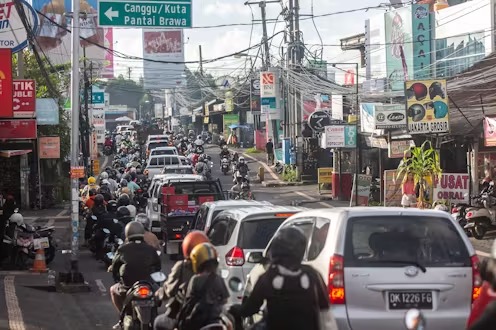
The steady rise in tourists mean the roads in Bali get busier every year. There is a roughly one-to-one ratio of vehicles to people on the island, while public transport use remains low. Congestion prevented travellers entering and leaving Bali’s airport for six hours ahead of New Year’s Eve 2023.
In rural Bali, the hilly terrain, tropical weather and poorer public transport mean residents must rely on cars and motorbikes. The resulting noise and pollution degrades the rural experience. Converting these vehicles to run on electricity would not solve the problem entirely if most power in Bali remains fossil-sourced. Nor would it cut road congestion.
Tourists want to visit lots of places in rural Bali with a reliable source of transport. The limited options have prompted many to rent cars or motorbikes, but weak traffic enforcement has allowed misbehaviour: tourists driving without shirts or helmets – or even licenses. The regional government temporarily banned motorbike rentals for foreigners in March 2023.
Despite chaotic traffic on the island, residents have found work transporting tourists informally for decades. That’s why efforts to ease congestion and travel chaos, by designing public transport for tour groups or free shuttle bus services, have met with local protests and the ire of vehicle rental businesses.
To travel or not to travel
Unbridled development squanders the mutual benefits that tourism can have for residents and visitors. Likewise, neither residents nor tourists should be prohibited from travelling, but should instead travel responsibly.
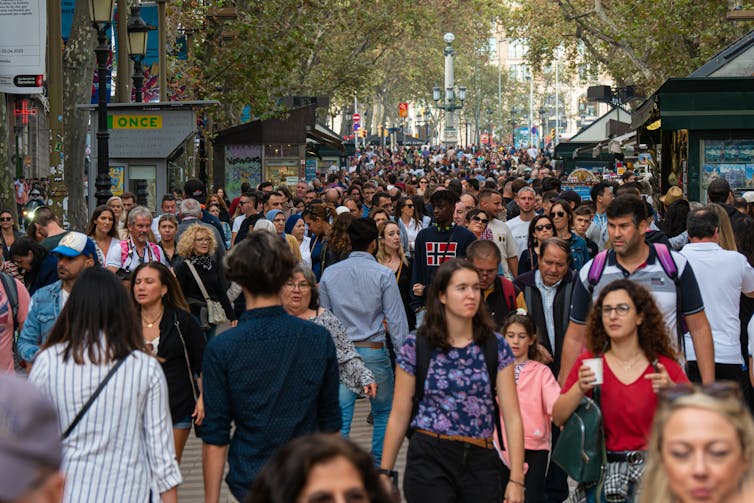
Barcelona crowds in October 2022. Mike Workman/Shutterstock
A railway transport plan that promises to connect Bali’s airport with Seminyak and Nusa Dua, the most popular areas in urban Bali, could help ease road traffic around the city centre. Local vehicle rental businesses could continue to operate in rural areas, but restrict their riders to less busy roads.
Poor destinations should be cautious about depending on tourism in the long term. The Balinese government is exploring its options in other sectors at least, such as agriculture and the digital economy.
Poorer destinations such as Bali are less well equipped than richer countries to manage the socioeconomic and environmental costs of overtourism. And ultimately, a swollen tourism sector contains the seeds of its own demise: declining environmental quality, unhappy residents and eventually, fewer tourists.







