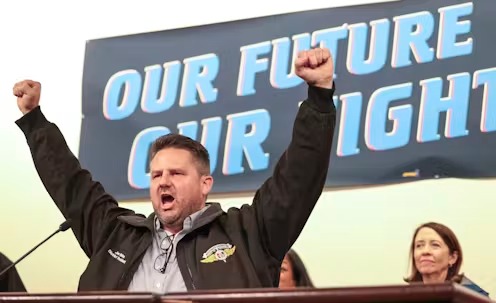
Striking workers at Boeing Defense overwhelmingly voted 90% in favor of a new four-year contract proposed by union leaders, the International Association of Machinists and Aerospace Workers (IAM) announced Friday. The vote comes as the 46-day strike continues to slow production of military aircraft, with Boeing management rejecting the deal as a “publicity stunt.”
IAM District 837 President Tom Boelling said members are prepared to return to work once Boeing accepts the offer, which mirrors retirement contributions and ratification bonuses won by other Boeing machinists. The proposal includes higher wage increases, larger bonuses, and greater retirement contributions than Boeing’s previous offer, which featured a 20% wage hike and additional vacation. According to IAM, the union’s plan would cost Boeing roughly $40 million annually, compared to $30 million under the company’s terms.
Boeing Defense Vice President Dan Gillian defended management’s offer, stating the company would not agree to significantly higher costs. Boeing has also threatened to hire replacement workers in its St. Louis facilities, where the strike has slowed production of fighters, munitions, and other defense programs despite the use of non-union labor.
The strike began August 4 after members rejected Boeing’s second offer, with 57% voting against it on September 12. With talks stalled, the IAM took the unusual step of drafting its own contract to pressure Boeing into resuming negotiations. Union leaders note the tactic has ended strikes in the past.
Political pressure is also mounting. Several U.S. lawmakers, including Missouri Senator Josh Hawley, have urged Boeing to negotiate, criticizing executives for prioritizing paychecks over workers. Boeing CEO Kelly Ortberg has downplayed the financial impact, noting it is smaller than last year’s 53-day strike in Washington and Oregon.