


 Gold Prices Fall Amid Rate Jitters; Copper Steady as China Stimulus Eyed
  Best Gold Stocks to Buy Now: AABB, GOLD, GDX
  France to Release 10 Million Barrels of Diesel to Ease Fuel Prices
  Asian Currencies Mixed as Yen Weakens, Dollar Holds Firm
  Mike Rogers Calls for End to US-Canada Tariff War
  RBI Raises Repo Rate to 5.50% in Hawkish Shift on Inflation Risks
  Oil Prices Trim Gains After Trump Rules Out Iran Strikes Before Midterms
  Oil Prices Rise as Hormuz Risks Offset IEA Stock Release
  UK House Prices Flat in September as Mortgage Rates Weigh


 Add as a preferred source on Google
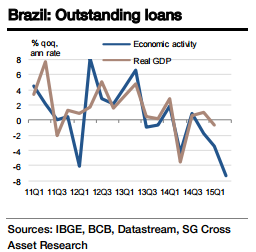
Brazil's economic activity index suggests that the supply-side economy contracted -7.3% qoq (annualised ) or -3.1% yoy in Q2.
"This prompts to project Q2 GDP growth of -1.7% qoq (-7.0% annualised or -2.7% yoy for the non-seasonally adjusted series), which is not significantly different from the earlier forecast. Yet, the economy seems to be heading for a worse contraction than it was expected until just a couple of months back. Both private and public consumption look in worse shape with the anticipated and significant fiscal drag from H2 and inflation set to continue to rise", Societe Generale.
Moreover, data through Q2 show no evidence of investment bottoming despite some gains on the export front (in volume terms) - primarily due to the depreciating currency. The lagged effect of higher interest rates will continue to exert downward pressure on investment, particularly in the current environment where confidence is extremely low.
"Assuming the fiscal situation remains stressed and the unemployment rate continues to rise, the economy will contract -2.1% in 2015 followed by -0.1% in 2016. The only upside, at this stage, could be a potential revival through trade channels. However, we are hesitant to take big bets on this as of yet", states SocGen.

- News

- Economy

- Central Banks
- Investing
- Research
- Roundups
- Digital Currency
- Insights
- Technical Analysis
- Technology
- Business
- Law
- Health
- Nature
- Fintech
- Science
- Topic
- Opinions
- ©Econometrics LLC . All Rights Reserved.
Brazil GDP likely to contract heavily in Q2
Friday, August 28, 2015 6:08 AM UTC
Editor's Picks



- Market Data
Most Popular




