


 Gold Prices Fall Amid Rate Jitters; Copper Steady as China Stimulus Eyed
  European Stocks Fall as Oil Rises Ahead of Fed Minutes
  UK House Prices Flat in September as Mortgage Rates Weigh
  Gold Prices Rise as Dollar Weakens, Treasury Yields Fall
  France to Release 10 Million Barrels of Diesel to Ease Fuel Prices
  Iran Refuses to Halt Uranium Enrichment Amid US Nuclear Demands
  Deere, CNH and AGCO Stocks Fall as FTC Launches Farm Equipment Probe
  Dollar Near 18-Month High as Euro, Yen and Pound Weaken
  Gold Prices Fall as Fed Signals Another Rate Hike
  Wall Street Falls as Fed Minutes Signal Another Rate Hike
  Oil Prices Rise as Gulf Hurricane and Middle East Supply Risks Mount
  Mike Rogers Calls for End to US-Canada Tariff War


 Add as a preferred source on Google
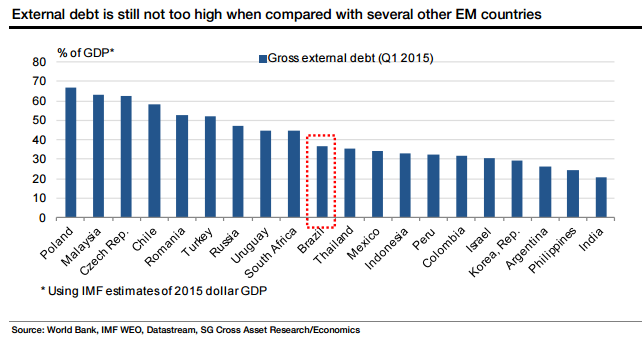
Brazil's external debt (ED) to GDP ratio - which declined to nearly 17% of GDP in 2008 and still stood at a moderate 25.2% at the end of 2013 - rose to 41% of GDP in Q3 15. While the increase in 2014 was driven by a rise in external borrowing, the recent increase in the ratio has been driven purely by the depreciation in the BRL that led to a contraction in dollar GDP. With the USD to BRL exchange rate expected to stay close to USD1= in Q4 15, the ED to GDP ratio is expected to rise to 45% of GDP this year.
Despite this significant increase, Brazil's ED to GDP ratio remains fairly comparable to that of most EM countries, including some Latam countries (Chile in particular). Furthermore, when looked at in isolation, it seems that the ED to GDP ratio itself is not all that threatening. Rather, it is Brazil's macro and financial situation that is responsible for the discomfort with the current level of ED to GDP ratio.

- News

- Economy

- Central Banks
- Investing
- Research
- Roundups
- Digital Currency
- Insights
- Technical Analysis
- Technology
- Business
- Law
- Health
- Nature
- Fintech
- Science
- Topic
- Opinions
- ©Econometrics LLC . All Rights Reserved.
Brazil’s external debt is not among the worst in the EM world
Wednesday, September 30, 2015 8:53 PM UTC
Editor's Picks



- Market Data
Most Popular




