


 Bitcoin Price Falls Below $83K as Liquidations Hit $697M
  Robinhood Buys $25 Million in Bitcoin for Corporate Treasury
  Chainlink Price Drops 3% Despite New CCIP Vault Launch
  XRP Whale Activity Drops 27% in Eight Days Amid Market Sell-Off
  U.S. Government Moves Over $100M in Bitcoin and BNB
  Bitmine to Stop Ethereum Buying After Reaching 5% ETH Supply
  XRP Ledger Activates New Security Feature for Banks and Stablecoins
  Jameson Lopp Downplays AI Threat to Bitcoin Cryptography
  Ethereum Price Drops Below $2,600 as Long Liquidations Hit 4-Month High
  Cardano Price Eyes $0.30 as ADA Whale Activity Surges
  Circle Stock Falls 4% as Crypto Selloff Overshadows SAP Pay Expansion
  Kazakhstan and Tether Explore Tenge Stablecoin and RWA Tokenization
  David Schwartz to Reveal XRP Ledger Future at Ripple Swell 2026
  US Government Moves $1 Billion in Bitcoin Amid Sale Speculation


 Add as a preferred source on Google
Chinese auto manufacturers got a big boost after government on September 30th slashed the purchase tax on small cars by half to 5% for passenger vehicles with engines that are 1.6 liters or smaller. The move can benefit both buyers and automakers. As a result, in two trading days, auto stocks listed on Shanghai Stock Exchange went limit up 10% - 30%. What does China's sales tax cut mean for the economy?
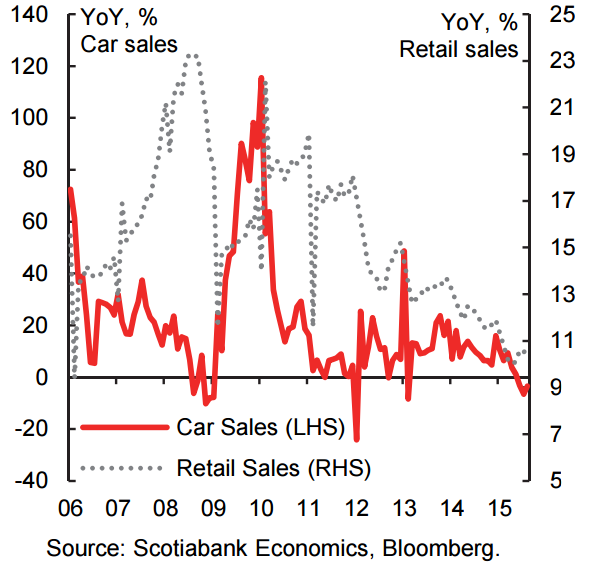
Beijing has done this before, in 2009, when it implemented a similar tax cut, bringing sales growth from negative territory in the fourth-quarter of 2008 to over 50% growth rate in 2009. Can the same trick work again? The move may seem minor, but it has important economic and policy implications worth recognizing in the broader China context.
While it's true that most economic activity indicators have softened this year, car sales have been particularly weak in recent months, substantially underperforming overall retail sales growth of +10.8% y/y. The rate cuts announced by PBoC have not had much impact on the country's sagging economic growth. However, a purchase tax cut could have some impact, as it directly benefits consumers.
"We estimate that auto sales and production account for more than 10% of the economy. More than 70% of all passenger vehicles sold in China have engine capacity of less than 1.6 liters, so the tax cut is well targeted to hit the majority of the sector", said Scotiabank in a research note.
Lower vehicle prices could benefit China's faltering car sales. From a demand-side perspective, there is plenty of capacity for the industry to grow domestically. Many fence sitters tend to move up their planned purchases to take advantage of such measures. Moody's expects the tax cut to be attractive to price-sensitive buyers and said that the limited duration of the tax cut will entice buyers to move up their purchases.
"While the impact will likely be more subdued in this slower growth environment, we expect the tax cut to help support the purchase of at least an additional one million vehicles", added Scotiabank.
The tax cut may initially appear to be a narrow fiscal target, but the move is intended to stimulate broader economic growth. It emphasizes policymakers' ongoing focus on the auto sector as a key driver of growth and employment in the Chinese economy. Moreover, the expiry date on the stimulus, valid only until December 2016, is clearly intended to create an immediate jumpstart to growth.
"GDP growth might not pick up as rapidly as it did in 2009, and the passenger vehicle penetration rate is much higher now than in 2009. Therefore, we believe the positive impact should be less significant this time. We increase our 2015e/16e PV sales volume growth forecasts to 2.0%/6.3%YoY from 0.5%/4.1%," forecasts HSBC Economics in a report.
USD/CNY is trading at 6.3328 as of 1014 GMT. Hang Seng index closed up 1.2 pct at 22,730.93 point, Shanghai composite index up 3.3 pct at 3,287.66 points with volumes highest since sept 2.

- News

- Economy

- Central Banks
- Investing
- Research
- Roundups
- Digital Currency
- Insights
- Technical Analysis
- Technology
- Business
- Law
- Health
- Nature
- Fintech
- Science
- Topic
- Opinions
- ©Econometrics LLC . All Rights Reserved.
Can China's auto sales tax cut have a significant impact on GDP growth?
Monday, October 12, 2015 11:16 AM UTC
Editor's Picks



- Market Data
Most Popular




