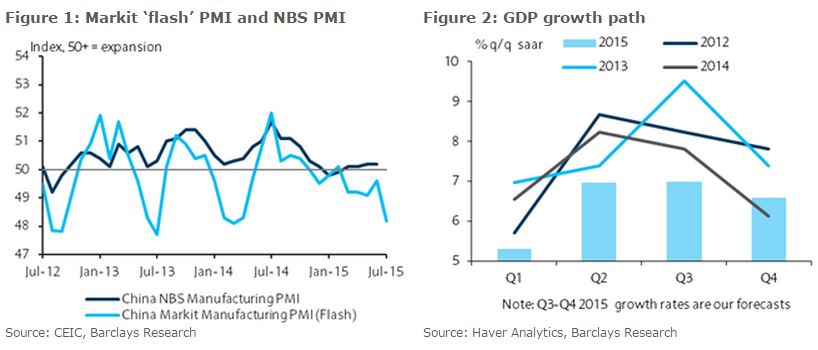
The Markit “flash” manufacturing PMI unexpectedly fell to 48.2 in July, reaching a 15-month low. The headline PMI deteriorated from its final reading of 49.4 in June, with the output sub-index worsening to 47.3, a 16-month low. The new orders sub-index fell to 48.1 from 50.3 in June, accompanied by soft new export orders. The decline in the output prices and input prices sub-indexes accelerated, a trend that is likely to continue to exacerbate PPI deflation and weigh on manufacturing activity. The employment conditions component remained soft, reflecting corporates’ muted expectations for demand conditions both at home and abroad, although it declined at a slower rate in July.
The weaker PMI supports our view that the economy is not on solid footing, and we look for a flat growth profile in H2. Electricity consumption, auto sales and company-level evidence suggest growth has remained soft. The leverage-driven equity boom-bust has hurt sentiment and poses downside risks to growth. Falling commodity prices are also likely to discourage restocking and investment. With the government appearing comfortable about the labour market situation in Q2, we expect flat sequential growth momentum of 7.0% q/q saar in Q3 and 6.6% in Q4, from 7% in Q2.
"We expect the overall fiscal and monetary policy mix to stay accommodative, although the pace of broad-based monetary easing is likely to slow. We expect fiscal policy to be more expansionary, with increasing local government spending to support investment, particularly in infrastructure. The possible announcement of a third CNY1trn local government debt swap plan, with close to CNY1trn completed so far, should help to support local government spending. We believe the continued downside risks to growth and the expected large pipeline of local government debt issuance justify further monetary easing. Therefore, in addition to the recent interest rate cut and targeted RRR reduction, we continue to look for one benchmark rate cut of 25bp in Q3 and one to two RRR cuts of 50bp each in H2 15, depending on liquidity conditions. Meanwhile, the state council this week made an explicit comment that “China will expand the CNY two-way trading range”. We note that on 15 March 2014, the PBoC widened the USDCNY trading band to ±2% from ±1%, after similar statement about the two-way trading range was made in a government work report issued on 5 March 2014," Barclays Research noted in its research report.