


 Best Gold Stocks to Buy Now: AABB, GOLD, GDX


 Add as a preferred source on Google
China’s economic growth, in spite of better momentum, is expected to decline further in coming years because of structural adjustment. Furthermore, it faces the risk of trade tension with the U.S., capital outflows and a housing bubble that might trigger fears of devaluation.
In the past few months, China’s economy has provided good news. While growth in consumption and the service sector has stayed strong, the greatest rebound was seen in the industrial sector. There have been decline in inventories, while orders picked up and both rail freight and electricity consumption have increased sharply.
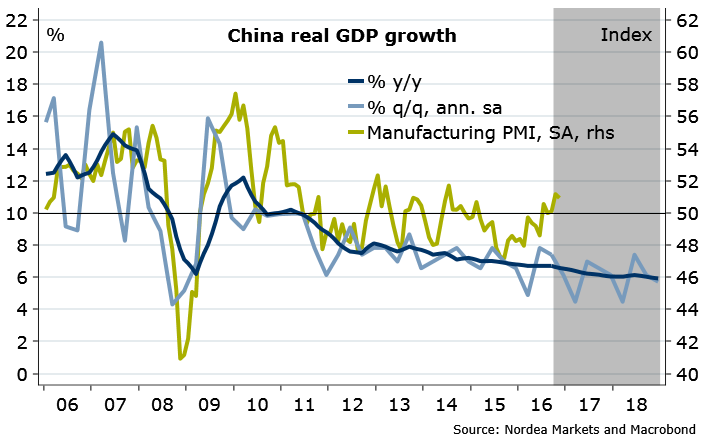
Therefore, the economic growth of China has stayed stable at 6.7 percent year-on-year for the initial three quarters in 2016. Manufacturing demand has increased, owing to sharp rise in infrastructure investment, as a part of government stimulus, and construction investment, due to the housing market recovery, noted Nordea Bank in a research report.
“The expectation of continued expansive fiscal policy has led us to revise our growth forecasts up to 6.6 percent this year, 6.2 percent in 2017 and 6 percent in 2018 from 6.5 percent, 6 percent and 5.8 percent, respectively, in September”, added Nordea Bank.
But, the positive momentum seen at present is not equivalent to better growth fundamentals. The economy continues to be imbalanced with overreliance on manufacturing and investment. The structural adjustment of capacity reduction, deleveraging and, in general, a transition towards consumption and services suggest a downward trend for GDP growth in the years ahead.
The sentiment is likely to weaken in the near term. Firstly, the concern regarding large capital outflows restricts the room for additional monetary easing. The Chinese central bank, People’s Bank of China, has tightened the interbank liquidity in the last two months to curtail outflows. And secondly, the housing market is easing due to official attempts to deflate the property bubble. Therefore growth in manufacturing demand is expected to slow down in 2017, according to Nordea Bank.

- News

- Economy

- Central Banks
- Investing
- Research
- Roundups
- Digital Currency
- Insights
- Technical Analysis
- Technology
- Business
- Law
- Health
- Nature
- Fintech
- Science
- Topic
- Opinions
- ©Econometrics LLC . All Rights Reserved.
China’s economic growth to decline further in years ahead on structural adjustment, says Nordea Bank
Monday, December 12, 2016 7:28 AM UTC
Editor's Picks



- Market Data
Most Popular




