
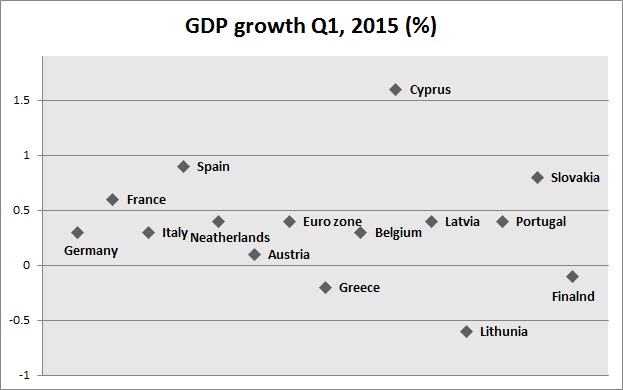
In spite of return of inflation and large scale jump in Markit PMI statistics, latest GDP statistics shows, there are still considerable slack remain across Euro zone countries and growth remains quite diverge.
- However, despite the slack in the economy, it can be said that growth is returning and recovery is in progress and economic slack is pointing that it will take some years before European Monetary Union returns to its full potential.
Naturally, European Central Bank (ECB) will keep monetary policy over the longer against expectation of rapid unwinding and tapering.
Key highlights -
- Seasonally adjusted GDP rose by 0.4% in European monetary union (EMU) in first quarter of 2015, compared with the previous quarter according to second flash estimates. Seasonally adjusted GDP rose by 1.0% in the euro area in the first quarter of 2015, after +0.9% in the previous quarter.
- In the fourth quarter of 2014, GDP grew by 0.3% in the euro area from a year ago.
- Growth was negative in Greece (-0.2%), Finland (-0.1%) and Lithuania (-0.6%).
- Highest level of growth was recorded in Cyprus at 1.6%. France grew faster (0.6%) that Germany (+0.3%).
- Spain registered high level of growth in first quarter (+0.9%).
As growth remains weak, ECB is likely to continue its bond purchase without any tapering or restructuring.
That makes European assets look more lucrative as growth returns. Euro is currently trading at 1.123 against dollar and Eurostxx50 is trading at 3502.


