
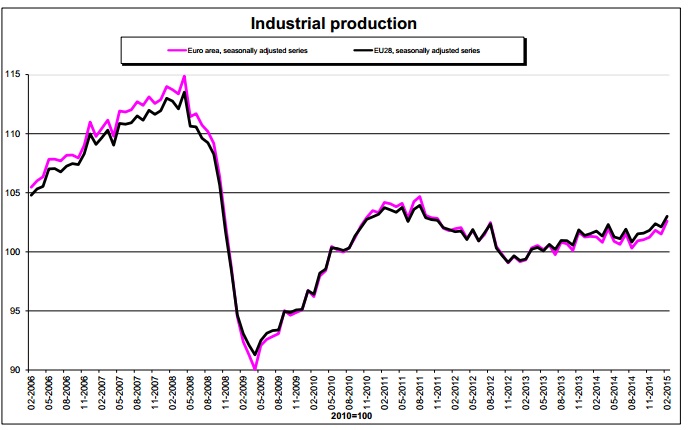
Central bank's massive easing paving the way to recovery for Euro zone.
- Euro zone Industrial production grew 1.1% m/m in February and 1.6% yearly basis.
However recovery is not uniform, some countries continue to pose weakness, while others strength.
Key highlights -
- Malta and Portugal registered negative growth, -1.3% and -0.5% respectively.
- Greece surprisingly registered production growth of 2.5%.
- Ireland once again proved itself as poster child of austerity and Euro zone recovery registered 16.3% growth in production.
- Non-durable consumer goods registered highest growth of 1.6%, production of immediate goods registered lowest growth of 0.3%.
Policy debate at ECB -
- Euro zone's comeback to recovery will encourage the policymakers, those voiced for quantitative easing.
- However rising inflation alongside will heat up the debate as German Bundesbank remained harsh critique of QE's effect on inflation.
As per today's data consumer prices rose 2% and 2.1% m/m in Spain and Italy respectively. Such rises are still a contribution of higher input and import costs due to lower Euro. Nevertheless inflation expectations are on the rise in Euro zone.
Improved economic dockets, weaker Euro and ECB bond purchase will continue to boost European stocks further which as of now hovering around 15 year high while some like German DAX is trading at all time high.


