

In 1948, the Treaty of Friendship, Cooperation, and Mutual Assistance was signed between the Soviet Union and Finland, providing a key basis for relations between the two states that was to last throughout the cold war. With memories of the 1939 “winter war” between the two still acute, the agreement embodied the Paasikivi–Kekkonen doctrine, named for two of Finland’s post-war presidents who developed the idea between 1946 and 1982 of a neutral Finland in close proximity to the USSR.
It also set the context for the term “Finlandisation” used by international relations scholars to describe external interference by a powerful country in the foreign policy of a smaller neighbouring state. A year later, on April 4 1949, the North Atlantic Treaty was signed by the 12 founding members of Nato.
Throughout the cold war, Finland remained a neutral state – although more due to circumstance than by choice. And despite its 1,340km (832 mile) border with Russia, it chose not to join Nato in the late 1990s, even as many of its eastern European neighbours did. It officially abandon its policy of neutrality in 1994, joining Nato’s Partnership for Peace and then the European Union in 1995. But aspirations to become a full Nato member state had not quite matured. That all ended with Russia’s second invasion of Ukraine in February 2022.
Finland (and Sweden) submitted their formal applications to join the alliance on May 18 2022 and this was endorsed by Nato members at the most recent summit in Madrid in June.
Although accession to Nato membership was relatively quick, there were objections from some members, most notably Turkey and, to a lesser extent, Hungary. Turkey held up membership for Finland – and is still doing so for Sweden – due to its concerns over what it called support for terrorist groups, namely the Kurdistan Workers’ party (PKK). Hungary also raised objections due to what it regarded as criticism by the Nordic states with regard to the strength of Hungarian democracy. But Nato chief Jens Stoltenberg said recently he is confident that Sweden could become a member by summer.
View from Moscow
If Putin was hoping to achieve the Finlandisation of Nato as one of his strategic aims of the war, what he has actually achieved was the “Natoisation” of Finland since it has now become the alliance’s 31st member state. With this comes Article 5 guarantees – the an attack on one member is an attack on the alliance as a whole and must be responded to as such. This fundamentally changes the defence and security posture of Finland, and European security architecture as a whole. Implications include the size and geographical focus of the alliance (even more so if Sweden joins in the not-too-distant future) as well as inter-organisational relations between Nato and the EU, the other key pillar of the European security architecture.
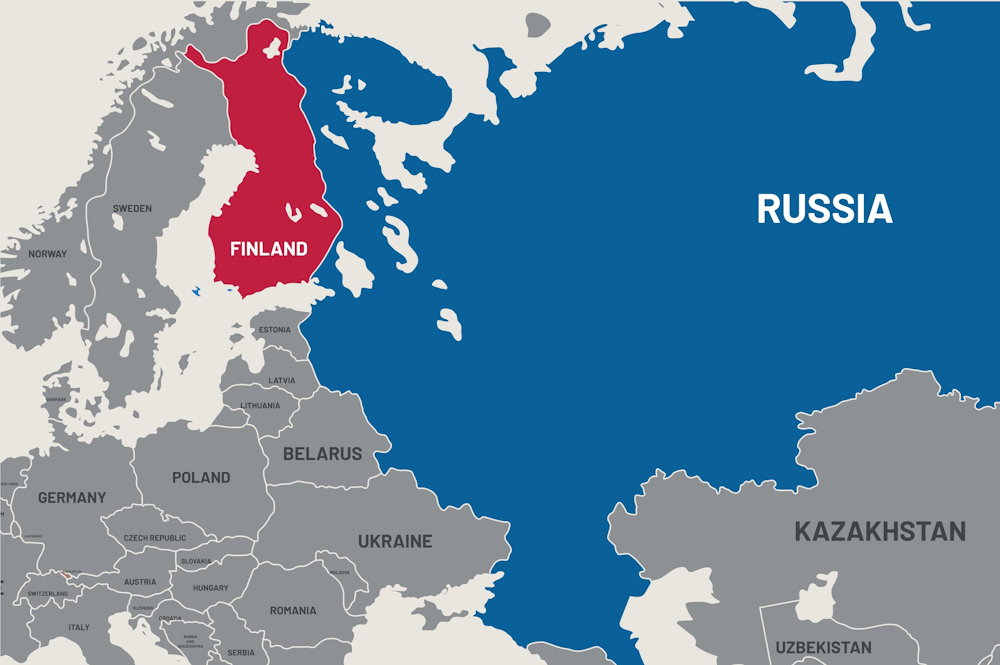
The addition of Finland as its 31st member effectively doubles the length of the border between Nato and Russia. buraktumler via Shutterstock
And Finland is not playing catch up in order to meet its Nato commitments. In fact, Finland will be a net contributor to the alliance’s overall collective defence. Over recent years, it has been modernising its armed forces, purchasing robust military capabilities and, unlike the majority of member states, it meets the Nato target of 2% of GDP spent on its own defence.
Putin has, of course, issued warnings to Finland (and Sweden) about joining the alliance. In 2016, Putin stated that “When we look across the border now, we see a Finn on the other side. If Finland joins Nato, we will see an enemy.”
Although there have been mixed signals with regard to Russia’s views on the sovereign right of Finland to join a collective defence organisation if it so chooses (although Russia does not extend this position to Ukraine itelf), it is gravely concerned that Nato will position military capabilities in Finland, on its border – and in close proximity to Russia’s own strategically important bases and geography.
Although Russia is very much focused on correcting its strategic blunders in Ukraine, it will at some stage begin to recover and, therefore, reconstitute its armed forces and military posture. Of particular concern could be Russia’s increased dependency on its tactical nuclear posture to offset its (temporarily) decreased capacity with regard to conventional capabilities.
Although we do not know what the future holds, given both the duration and eventual outcome of the war, Russia will continue to have security concerns. And now it has a border with Nato that will run from the High North down to the Black Sea and beyond. This is guaranteed to lock in continued tensions between the alliance and Russia for years to come.
Nato fundamentally thinks of itself as a collective defence organisation, with (nuclear) deterrence as its core strength. Russia will continue to see the alliance as a key stalwart undermining its threat perceptions and ability to affect its own near abroad. So as the Finnish flag is raised at Nato HQ in Brussels, It would be naïve to think that Russia will not respond – even if its power to do so is currently somewhat diminished.


