


 China's Refining Industry Faces Major Shakeup Amid Challenges
  Mexico's Undervalued Equity Market Offers Long-Term Investment Potential
  Geopolitical Shocks That Could Reshape Financial Markets in 2025
  Moody's Upgrades Argentina's Credit Rating Amid Economic Reforms
  Gold Prices Slide as Rate Cut Prospects Diminish; Copper Gains on China Stimulus Hopes
  Stock Futures Dip as Investors Await Key Payrolls Data
  Goldman Predicts 50% Odds of 10% U.S. Tariff on Copper by Q1 Close
  Energy Sector Outlook 2025: AI's Role and Market Dynamics
  U.S. Stocks vs. Bonds: Are Diverging Valuations Signaling a Shift?
  European Stocks Rally on Chinese Growth and Mining Merger Speculation
  S&P 500 Relies on Tech for Growth in Q4 2024, Says Barclays
  UBS Projects Mixed Market Outlook for 2025 Amid Trump Policy Uncertainty
  Indonesia Surprises Markets with Interest Rate Cut Amid Currency Pressure
  U.S. Treasury Yields Expected to Decline Amid Cooling Economic Pressures
  2025 Market Outlook: Key January Events to Watch
  U.S. Banks Report Strong Q4 Profits Amid Investment Banking Surge
  US Futures Rise as Investors Eye Earnings, Inflation Data, and Wildfire Impacts


 Add as a preferred source on Google
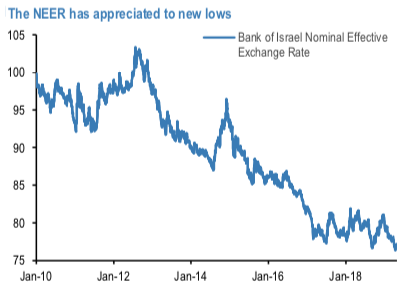
We could foresee scope for depreciation for Israeli currency as limited from the current levels and in fact, we see increasing risks of USDILS trading higher. With ILS one of the strongest performers among EMEA EM YTD (+ 4% in spot terms vs USD), the BoI’s change in rhetoric with regards to their intervention policy will likely shackle shekel appreciation.
The fundamentals such as the BoP support to deteriorate again. However, for now, there is no strong driver to initiate ILS shorts, even as the balance of risks is shifting towards USDILS higher. Thus, sidelined sentiments are prevailing in FX avenue, but hold a 5y IRS receiver in rates. The BoI will likely limit further strength in the Shekel.
However, with the nominal effective exchange rate appreciating to record lows (refer 1st chart), the BoI has seemingly changed their rhetoric in the latest MPC minutes: "if the appreciation continues, the Bank of Israel will consider using the tool of intervention in the foreign exchange market". This indicates that any further shekel appreciation will likely be contained by a more proactive FX intervention policy.
While on the other hand, both CNY and CNH returned to the pre-G20 Finance Ministers and Central bank Governors Meeting level. President Donald Trump said that he personally held up a trade deal with China and an agreement is unlikely to be reached unless Beijing returns to the terms negotiated earlier. However, Trump’s rhetoric didn’t bring about too much impact onto the FX markets.
While lower institutional investor FX hedge ratios could also weigh on shekel. The direction of USDILS often tends to move in tandem with shifts in Israeli institutional investor behavior (refer 2nd chart).
The level of hedging behavior is likely driven in part by Israel’s carry differentials to the US dollar. With Israeli inflation contained and expected to drop to 0.9% yoy in May-19, way below the BoI's 1-3% target band, and the BoI sounding modestly dovish at its latest meeting. The analysts won’t see the next BoI hike until 2Q’20.
On the flip side, the US Federal Reserve is expected to remain on hold through to end 2020 too, and with the Fed recently pushing back against the idea of “insurance cuts”, we thus expect the carry differential to remain elevated for the foreseeable future (3rdchart).
This suggests that FX hedge ratios are likely to stay low and FX- unhedged foreign asset buying relatively high. Courtesy: JPM
Currency Strength Index: FxWirePro's hourly USD spot index is creeping at 1 level (which is absolutely neutral), while articulating (at 13:22 GMT).
For more details on the index, please refer below weblink: http://www.fxwirepro.com/currencyindex







