1m ATM IVs are trending more than 11% which is favourable for option holders.
As you can glance through the skewness in 1m IVs of AUDUSD, they highlight more probabilities of underlying spot sensitiveness to the OTM strikes, and in turn, both the volatility and skewness implicit in option prices.
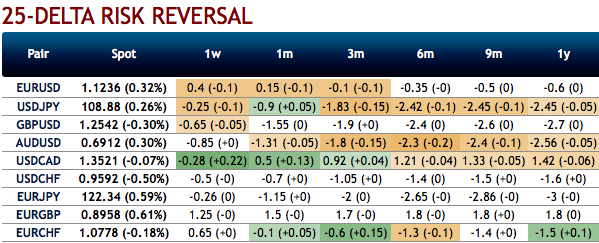
To substantiate these signals, we could also observe suitable bearish signals correspondingly offered by the delta risk reversals.
Alright contemplating above OTC observation of this pair, put back spread of this pair could be constructed by deploying 2 lots of 1M OTM puts while writing an ITM put.
The Black-Scholes IV curve is asymmetric in the overall sample, displaying a rising pattern with moneyness, and signalling a sharp left skew in the risk-neutral distribution of returns. Also, the IV curve is at, or slightly decreasing, with maturity.
Do note we need to evaluate the strategy payoff at various levels of expiry, as the strategy payoff is quite versatile.
This strategy profits when the stock price makes a strong move to the downside beyond the lower breakeven point. There is no limit to the maximum possible profit for the put back spread.
Maximum returns are unlimited and could be achievable when underlying spot FX is less than twice the strike price of long puts - strike price of short put + net credit received initially.
Hence, maximum profits of the strategy = strike price of long put - the price of underlying - max loss.
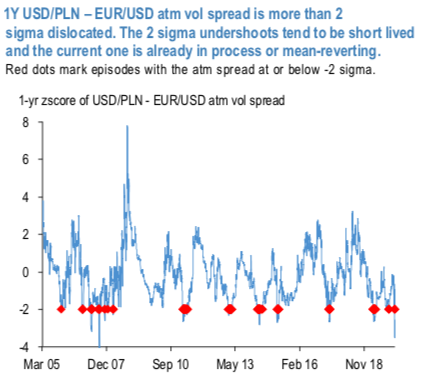
Well, the volatility is not money. There is a different frame of reference for it every day and strikes have many different proximities to the underlying stock price. Spreads, on the other hand, are easier to keep track of; the frame of reference is all of the other spreads.