


 Stock Futures Dip as Investors Await Key Payrolls Data
  UBS Predicts Potential Fed Rate Cut Amid Strong US Economic Data
  Monero Price Holds $515 Support as XMR Eyes $545 Breakout
  UNCX Network Hack Drains $86K From Ethereum Token Pool
  XRP Price Drops 3% Despite Ripple-Backed Evernorth Nasdaq Debut
  Mexico's Undervalued Equity Market Offers Long-Term Investment Potential
  Crypto Derivatives Dashboard: Bulls Retain Control Amid $488M Liquidation Flush
  Ripple Partners With DriveWealth to Expand RLUSD Settlements
  Bank of America Posts Strong Q4 2024 Results, Shares Rise
  Gold Prices Slide as Rate Cut Prospects Diminish; Copper Gains on China Stimulus Hopes
  Wall Street Analysts Weigh in on Latest NFP Data
  DeFi Development Adds 22,070 SOL to Solana Treasury
  Ripple-Backed Evernorth Set for Nasdaq Debut With 473 Million XRP
  Dogecoin Price Rebounds as DOGE Defends $0.08 Support
  Bitcoin Price Drops as US Dollar Hits 18-Month High
  U.S. Treasury Yields Expected to Decline Amid Cooling Economic Pressures


 Add as a preferred source on Google
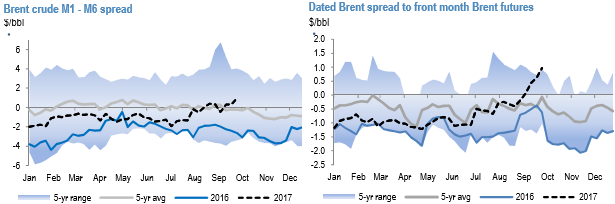
As a result of the bid from refineries in Atlantic Basin, crude markets have tightened further in recent weeks as still-healthy refining margins have lifted demand for crude. However, as we approach the end of 3Q’17 we expect this effect will likely fade. Nevertheless, Brent crude structure is back to levels last seen in mid-2014, (refer above diagram), as is Dated Brent pricing relative to front month Brent Futures, (refer above diagram).
The latter aspect of the cash crude market strength appears particularly bullish for outright prices. The discount, or premium, that Dated Brent can command relative to futures is a key measure for the tightness of the physical crude market. Typically, refineries will only pay a premium for cash cargoes –as measured by Dated Brent – versus the screen if it makes financial sense when they process the crude. Hence, a premium in this market implies genuine tightness that cannot be offset by economic run cuts or crude stocks draws. We view this development as a short-term cyclical support for prices.
We view the majority of the recent upswing in Brent crude futures structure as a cyclical response to the tightness in product markets following the loss of refinery supply from the US Gulf Coast.
As noted ahead of its landfall, USGC refineries are far more interlinked with international oil markets than the last time the market had to accommodate this scale of disruption.
While margins have largely normalized to pre-hurricane levels, they remain strong and the building evidence of stronger than anticipated demand growth could propel prices higher in the short term, even if much of the current tightness in crude and products markets could unwind as we start 4Q’17.
American Petroleum Institute is scheduled to announce its weekly report at 20:30 GMT, as speculators continue to ponder how would be influence of recent storm action was on demand/supply equation.
Brent futures, the benchmark for oil prices outside the U.S., shed 0.7% to $58.03. It reached a 26-month peak of $58.88 earlier in the session.
We encourage longs in the Brent $50-45/bbl put spread of December 2018 expiries. The put spread position for an initial premium of $2.10/bbl.
We reckon that prices would soften in 2018. Despite positive news flow surrounding this week’s Joint Monitoring Committee meeting, there appears limited appetite for additional production cuts. Even if prices rally in the short term, it appears an attractive risk-reward to be long this put spread for end 2018 pricing. Courtesy: JPM







